

 English
 Français
 Español
 Deutsch
 Português
 عربى



/SINCERE
contact information
info@sinceresafety.com
+86-190 5138 6834
High Tech industrial Park, Rudong County, Nantong City, Jiangsu Province, China.
-

WhatsApp
-

WeChat
-

Mobile

/Trends

Which Coated Glove Should You Choose
09 Nov 26
Content
- 1 PU, Nitrile, Latex, and PVC Coated Gloves at a Glance
- 2 PU Coated Gloves: Best for Precision and Light Work
- 3 Nitrile Coated Gloves: Best for Oily and General Mechanical Work
- 4 Latex Coated Gloves: Best Grip on Wet and Dry Surfaces
- 5 PVC Coated Gloves: Best for Liquids and Chemicals
- 6 Liner and Coating Coverage Also Matter
- 7 Reading Safety Ratings on Coated Gloves
- 8 Which Coating for Which Task
- 9 Fit, Care, and When to Replace Coated Gloves
- 10 Buying Checklist for Businesses
- 11 Frequently Asked Questions
- 11.1 1. What is the difference between PU Coated Gloves and Nitrile Coated Gloves?
- 11.2 2. Which is better for wet conditions, Latex Coated Gloves or PVC Coated Gloves?
- 11.3 3. Are Latex Coated Gloves safe for people with latex allergy?
- 11.4 4. Are Nitrile Coated Gloves chemical resistant?
- 11.5 5. What does the gauge of a coated glove mean?
- 11.6 6. What do the numbers on EN 388 gloves mean?
- 11.7 7. Can PU Coated Gloves be used with oil?
- 11.8 8. Can coated gloves be washed?
- 11.9 9. How do I choose the right size?
- 11.10 10. How long do coated gloves last?
Choose PU Coated Gloves for precise, light, dry work. Choose Nitrile Coated Gloves for oily and general mechanical work. Choose Latex Coated Gloves for the best grip on wet or dry surfaces. Choose PVC Coated Gloves when you handle liquids and chemicals. The coating decides how the glove grips, what it resists, and how it feels, and the knitted liner underneath decides comfort, breathability, and in many cases cut resistance.
No single coating wins every task. PU gives the thinnest, most sensitive feel but wears faster and slips on oil. Nitrile resists oil and wears well but is slightly less sensitive than PU. Latex grips best when things are wet but is poor against oil and can cause allergies. PVC resists many chemicals and keeps liquids out but is stiff and not breathable. The sections below compare the four, explain safety ratings, and give a task by task guide.
PU, Nitrile, Latex, and PVC Coated Gloves at a Glance
The ratings below are an indicative guide from 1 (low) to 5 (high). Real performance varies with the formulation, coating thickness, liner, and finish, so check each product's test data.
| Property | PU Coated Gloves | Nitrile Coated Gloves | Latex Coated Gloves | PVC Coated Gloves |
|---|---|---|---|---|
| Dexterity and feel | 5 | 4 | 4 | 2 |
| Dry grip | 4 | 4 | 5 | 3 |
| Wet grip | 2 | 3 | 5 | 3 |
| Oil and grease grip | 2 | 5 | 1 | 4 |
| Abrasion resistance | 3 | 4 | 4 | 4 |
| Chemical resistance | 1 | 3 | 2 | 5 |
| Breathability (palm coated) | 4 | 3 | 3 | 2 |
| Cold weather flexibility | 3 | 3 | 4 | 2 |
| Latex allergy risk | None | None | Possible | None |
PU Coated Gloves: Best for Precision and Light Work
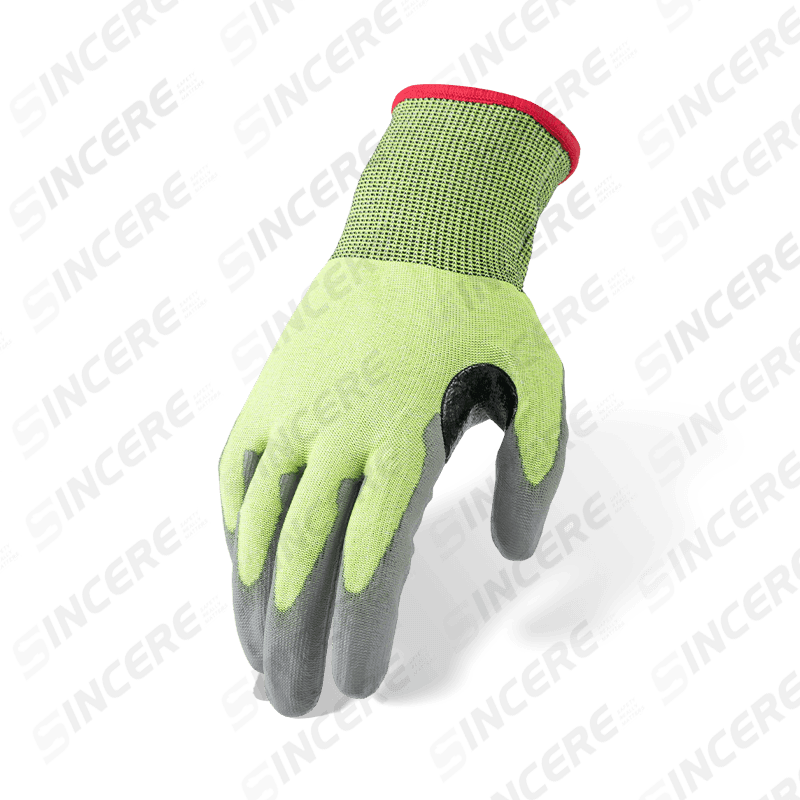
PU Coated Gloves have a thin layer of polyurethane on the palm and fingers of a knitted liner. The coating is soft and flexible, so the glove feels like a second skin and keeps the sensitivity needed to pick up small parts and tools. Palm coated versions leave the back of the hand uncoated, which lets heat and moisture escape and keeps the hand cooler.
Strengths of PU Coated Gloves
- Highest dexterity: thin liners of 13 or 15 gauge with a light coating allow fine finger movements.
- Good dry grip: the coating grips tools, boxes, and small components in dry conditions.
- Comfort and breathability: lightweight, flexible, and suitable for long shifts.
- No latex protein: suitable for people with natural rubber latex allergy.
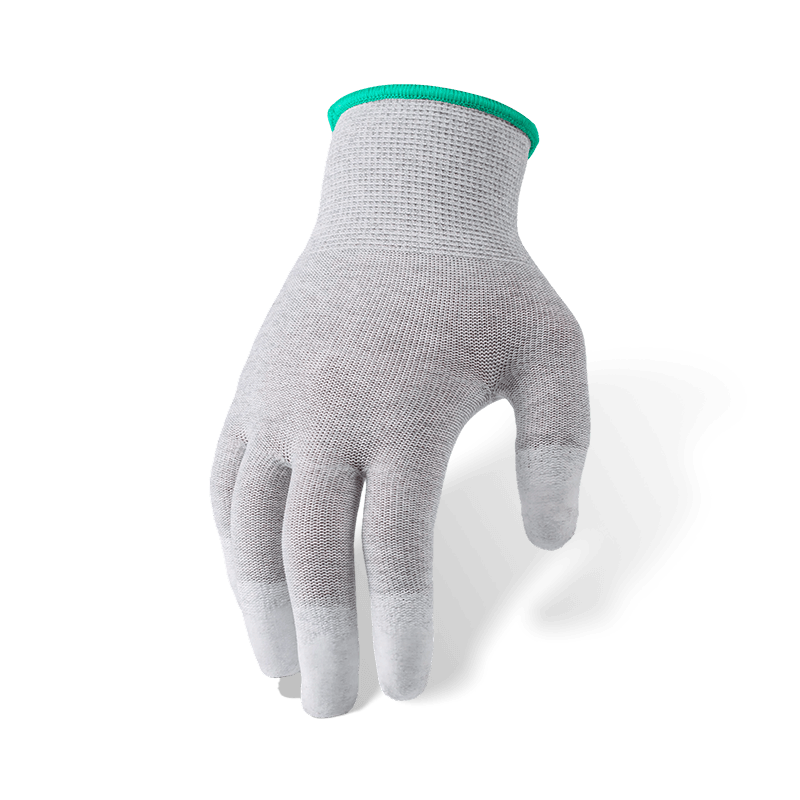
- Clean handling: low linting versions, and anti static versions with carbon fiber in the liner, are used in electronics work.
Limits of PU Coated Gloves
The thin coating wears out faster than nitrile or latex on rough surfaces, and it does not resist oil, solvents, or most chemicals. Grip drops on wet or oily parts. PU Coated Gloves are therefore the wrong choice for heavy abrasive tasks or for handling oily metal components.
Typical Uses
Electronics and light assembly, inspection, packaging, warehouse picking, automotive assembly of dry parts, and general light handling.
Nitrile Coated Gloves: Best for Oily and General Mechanical Work
Nitrile Coated Gloves use a synthetic rubber, nitrile butadiene, that resists oils, greases, and many fuels. The coating is tougher than PU, so the glove lasts longer on rough surfaces, and it is free of natural rubber latex protein. It is the most widely used coating for general industrial and mechanical work.
Common Nitrile Finishes
- Smooth nitrile: a thin, even coating with good feel and light oil resistance.
- Sandy nitrile: a rough micro texture that grips better on oily and wet parts, often with a thicker coating on the palm.
- Foam nitrile: a porous coating that is flexible and breathable, and that absorbs a little oil so the surface keeps its grip. It is popular in automotive and machinery work.
Strengths and Limits
Nitrile Coated Gloves resist abrasion, snags, and punctures better than PU, and they hold their grip in oil. They are a little less sensitive than PU, and their chemical resistance is limited: nitrile handles oils and many fuels well, but ketones and strong acids can damage it. For liquid chemical handling, use a glove with a certified chemical rating, not a general coated glove.
Typical Uses
Automotive repair and assembly, machine shops, metalworking, oily parts handling, construction, glass and sheet handling with a suitable liner, and general maintenance.
Latex Coated Gloves: Best Grip on Wet and Dry Surfaces
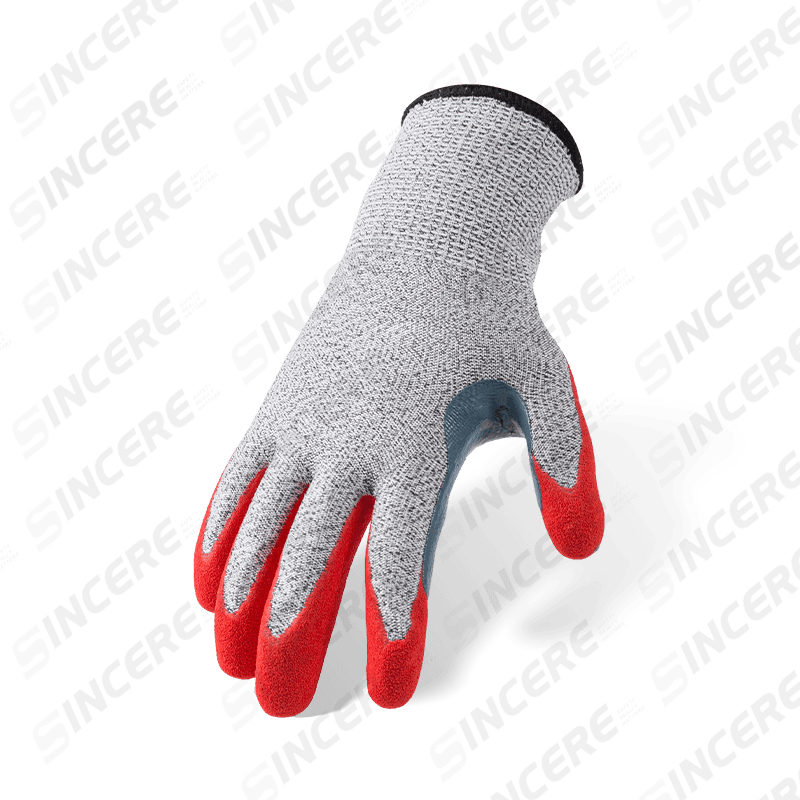
Latex Coated Gloves use natural rubber on the palm. Natural latex is elastic and tacky, so it grips extremely well on dry and wet surfaces, and it conforms closely to what you hold. Crinkle latex, with a wrinkled surface pattern, adds extra grip and allows water to escape from between the glove and the object.
Strengths of Latex Coated Gloves
- Superior grip: the best choice for wet bricks, wet timber, pipes, and slippery packaging.
- Flexibility and comfort: elastic coating that moves with the hand.
- Cold weather use: latex stays flexible in the cold, and gloves with a brushed or insulated liner give warmth.
- Good abrasion resistance: especially in crinkle finishes used on rough materials.
Limits of Latex Coated Gloves
Natural rubber latex contains proteins that cause allergic reactions in some people, ranging from skin irritation to more serious responses. Employers should consider this before issuing latex gloves widely. Latex also performs poorly against oils, grease, and many solvents, so it is unsuitable for oily work.
Typical Uses
Construction, bricklaying, gardening, landscaping, handling wet materials, packaging and warehouse work in cold or damp places, and general labor.
PVC Coated Gloves: Best for Liquids and Chemicals
PVC Coated Gloves have a polyvinyl chloride coating, often applied as a full dip that covers the whole glove, and sometimes with a long gauntlet cuff. A fully coated PVC glove keeps liquids out, resists many acids, alkalis, and oils, and stands up well to abrasion. Many PVC gloves are also used as heavy duty gloves for wet industrial work.
Strengths of PVC Coated Gloves
- Chemical and liquid resistance: suitable for handling many caustic and acidic liquids, depending on the formulation and the test certification.
- Oil and grease resistance: rough or sandy finishes keep grip in oily conditions.
- Tough and durable: a thick coating stands up to abrasion and rough handling.
- Long cuff options: gauntlet styles protect the wrist and forearm from splashes.
Limits of PVC Coated Gloves
PVC is stiffer and less sensitive than the other coatings, and a fully coated glove does not breathe, so hands get hot and damp during long use. Some PVC compounds become stiff in the cold. PVC is also not a replacement for chemical gloves that carry a tested permeation rating, so check the certification for the specific chemical.
Typical Uses
Chemical and cleaning work, oil and gas, fishing and fish processing, tank cleaning, wet industrial handling, and heavy duty maintenance.
Liner and Coating Coverage Also Matter
A glove is a system. The same coating performs differently on different liners, and the amount of coating changes protection and comfort.
| Liner Material | Main Benefit | Typical Pairing |
|---|---|---|
| Nylon | Thin, smooth, and strong | PU or foam nitrile for light work |
| Polyester | Durable, dries quickly, and holds its shape | PU or nitrile |
| Cotton | Soft, absorbent, and low cost | PVC dotted and latex gloves for general work |
| HPPE and glass fiber blends | High cut resistance | PU or nitrile for cut protection |
| Brushed acrylic | Warmth for cold work | Latex or PVC for winter gloves |
Knit Gauge
Gauge describes how fine the knit is. A higher number means thinner yarn and a finer, more sensitive liner. Typical choices are 18 gauge for ultra fine precision, 15 and 13 gauge for general light work, and 10 and 7 gauge for heavier, tougher gloves.
Coating Coverage
- Palm coated: the most breathable and flexible, and good for general work.
- Three quarter coated: covers the palm and the back of the fingers, so it protects more of the hand and resists more splashes.
- Fully coated: keeps liquids out completely, but it is the least breathable.
- Fingertip coated: maximum breathability and sensitivity for very light work.
Reading Safety Ratings on Coated Gloves
Look for the pictogram and the numbers beside it. In Europe and many other markets, the standard for mechanical risks is EN 388. A glove marked with a hammer pictogram shows four digits and sometimes a letter, in this order: abrasion, blade cut, tear, and puncture.
| Level | Abrasion (cycles) | Blade Cut (index) | Tear (newtons) | Puncture (newtons) |
|---|---|---|---|---|
| 1 | 100 | 1.2 | 10 | 20 |
| 2 | 500 | 2.5 | 25 | 60 |
| 3 | 2,000 | 5.0 | 50 | 100 |
| 4 | 8,000 | 10.0 | 75 | 150 |
| 5 | Not used | 20.0 | Not used | Not used |
For example, a glove marked 4131X has abrasion level 4, blade cut level 1, tear level 3, puncture level 1, and an X meaning the second cut test was not tested. A fifth marking, a letter from A to F, shows the result of the newer cut test under ISO 13997, from A at about 2 newtons to F at about 30 newtons. In North America, ANSI and ISEA 105 uses cut levels from A1 to A9, where A1 starts at 200 grams and A9 is 6,000 grams or more.
For chemicals, look for a rating under EN 374 or the equivalent, and for food contact, look for the glass and fork symbol or a stated food contact approval. A general coated glove is not a chemical glove unless its certificate says so.
Which Coating for Which Task
| Task | Suggested Coating | Reason |
|---|---|---|
| Electronics and fine assembly | PU on 15 or 18 gauge liner | Maximum feel and clean handling |
| Warehouse picking and packing | PU or smooth nitrile | Light, breathable, and good dry grip |
| Auto repair and machine shop | Sandy or foam nitrile | Holds oily parts, and resists oil |
| Construction and brickwork | Crinkle latex | Strong grip on wet, rough materials |
| Gardening and landscaping | Latex or nitrile | Grip on wet tools and soil |
| Chemical cleaning, wet industrial | PVC fully coated, certified gloves for chemicals | Liquid and chemical barrier |
| Glass, sheet metal, sharp edges | HPPE liner with PU or nitrile | Cut resistance with grip |
| Cold outdoor work | Latex on brushed liner | Warm and flexible with good grip |
Fit, Care, and When to Replace Coated Gloves
- Fit snugly: a glove that is too loose reduces control, and one that is too tight tires the hand. Common sizes run from 6 to 11, where 8 is roughly medium and 9 is large.
- Wash with care: many PU and nitrile gloves can be hand washed in mild detergent and air dried away from heat. Always follow the label, because heat and strong detergents damage coatings.
- Replace when worn: replace gloves when the coating is worn through, cracked, or peeling, when holes appear, or when the glove is contaminated with chemicals that cannot be washed out.
- Match gloves to the risk: do not use a general purpose glove where a certified cut, chemical, or heat glove is required.
Cost Per Day, Not Cost Per Pair
The cheapest pair is not always the cheapest to use. As an illustration, suppose a PU glove costs 0.60 USD a pair and lasts 3 working days, and a nitrile glove costs 1.00 USD and lasts 6 days on the same job. The PU glove costs 0.20 USD per day, and the nitrile glove costs about 0.17 USD per day. Track how long gloves last in your own work, then compare the cost per day.
Buying Checklist for Businesses
- Define the task and hazards: dry or wet, oily or clean, cut risk, chemicals, temperature.
- Choose coating and finish: PU, nitrile, latex, or PVC, with a smooth, sandy, foam, or crinkle finish as needed.
- Choose liner and gauge: nylon, polyester, cotton, or HPPE, in a gauge that balances feel and durability.
- Check certifications: EN 388 or ANSI ratings, and EN 374 for chemicals where needed, with test reports.
- Confirm sizes and packing: sizes 6 to 11, pairs per bag, and bags per carton.
- Request samples: test them on the real task for a few shifts before a bulk order.
- Ask about customization: liner color, coating color, and logo printing for branding.
Frequently Asked Questions
1. What is the difference between PU Coated Gloves and Nitrile Coated Gloves?
PU Coated Gloves are thinner and more sensitive, which suits light, dry, precise work. Nitrile Coated Gloves are tougher and resist oil, which suits oily and general mechanical work. Nitrile usually lasts longer, while PU feels more like bare hands.
2. Which is better for wet conditions, Latex Coated Gloves or PVC Coated Gloves?
Latex Coated Gloves grip better on wet surfaces, especially in crinkle finishes. PVC Coated Gloves keep water and liquids out and resist chemicals, but are stiffer. Choose latex for grip and PVC for liquid protection.
3. Are Latex Coated Gloves safe for people with latex allergy?
No. Natural rubber latex contains proteins that can trigger allergic reactions. People with a latex allergy should use PU, nitrile, or PVC coated gloves instead.
4. Are Nitrile Coated Gloves chemical resistant?
They resist oils, greases, and many fuels, but they are not chemical protection gloves. Ketones and strong acids can damage nitrile. For chemicals, choose gloves with a tested rating for the specific chemical.
5. What does the gauge of a coated glove mean?
Gauge is the fineness of the knitted liner. A higher gauge, such as 15 or 18, means thinner yarn and better feel. A lower gauge, such as 7 or 10, means a thicker, tougher liner.
6. What do the numbers on EN 388 gloves mean?
The four digits are abrasion, blade cut, tear, and puncture, in that order, with higher numbers meaning better performance. A letter from A to F after them shows cut resistance by a newer test. For example, 4131X means abrasion 4, cut 1, tear 3, puncture 1.
7. Can PU Coated Gloves be used with oil?
Only for light contact. PU has poor grip and resistance to oil. For oily work, choose sandy or foam Nitrile Coated Gloves, or PVC Coated Gloves with a rough finish.
8. Can coated gloves be washed?
Many can be hand washed in mild detergent and air dried, but always follow the label. High heat, strong detergents, and solvents damage coatings and shorten life.
9. How do I choose the right size?
Measure around the palm and match it to the maker's size chart, usually from 6 to 11. Choose a snug fit that allows free finger movement. A glove that is too loose reduces control, and one that is too tight reduces comfort and blood flow.
10. How long do coated gloves last?
It depends on the task, the coating, and the surface. Light assembly may use one pair for weeks, while abrasive work can wear a pair out in days. Track the wear in your own work, and replace gloves when the coating is worn, cracked, or peeling.



LEVERAGE OUR INNOVATIVE YARN TECHNOLOGY TO UNLOCK NEW MARKET POTENTIAL FOR YOUR BRAND.
Start Your Custom ConsultationCopyright © Nantong Sincere Safety Products and Technology Co., Ltd. All Rights Reserved
