

 English
 Français
 Español
 Deutsch
 Português
 عربى



/SINCERE
contact information
info@sinceresafety.com
+86-190 5138 6834
High Tech industrial Park, Rudong County, Nantong City, Jiangsu Province, China.
-

WhatsApp
-

WeChat
-

Mobile

/Trends

ANSI Cut Levels A1–A9 Explained: How to Choose the Right Cut Resistant Gloves
13 Nov 26
Content
- 1 What the ANSI/ISEA 105 Cut Scale Actually Measures
- 2 The Nine Levels, One by One
- 2.1 A1 and A2: Light Contact, High Dexterity
- 2.2 A3: The Working Floor of Real Cut Protection
- 2.3 A4: The Level Most Industrial Tasks Actually Need
- 2.4 A5: Where Sharp Edges Become Routine
- 2.5 A6: Heavy Cut Exposure With Control
- 2.6 A7 and A8: High-Force Cutting Environments
- 2.7 A9: Maximum Cut Resistance and Its Real Limits
- 3 A Visual Comparison of the Nine Cut Levels
- 4 ANSI A1–A9 and EN388 A–F: Two Scales, One Idea
- 5 Why the Highest Cut Level Is Usually the Wrong Default
- 6 Gauge, Fiber and Coating: What Actually Moves the Number
- 7 A Five-Step Method for Choosing a Cut Level
- 8 Matching Levels to Everyday Work Situations
- 9 Misunderstandings That Lead to the Wrong Glove
- 10 Care, Inspection and the Signals That Say Replace
- 11 When Cut Protection Has to Share Space With Other Risks
- 12 Questions We Hear Most Often
- 12.1 Is A9 the safest glove I can buy?
- 12.2 Can I compare an A4 glove from one supplier with an A4 glove from another?
- 12.3 Does a higher gauge mean lower cut resistance?
- 12.4 How often should cut-resistant gloves be replaced?
- 12.5 Do cut-resistant gloves work with touchscreens?
- 12.6 What information should I ask a supplier for?
ANSI cut levels A1 through A9 describe how much cutting force a glove material survives before a blade passes through it. The scale is written in grams, begins at A1 where a blade needs 200 to 499 grams to cut through, and ends at A9 where the material holds out against 6,000 grams or more. The purpose of the scale is plain: it gives a buyer, a safety manager and a line supervisor a shared number to argue about instead of a shared adjective. "Heavy duty" means something different in a sheet metal shop than in a glass plant, but A5 means the same thing in both places.
Inside a glove factory, that number is never the starting point. It is the result. Before a style earns an A4 or an A6, we have already made decisions about yarn blend, knitting gauge, coating chemistry, thumb crotch reinforcement and how much of the palm the coating covers. Change any one of those and the tested level moves. That is why a cut level printed on a glove is a summary of a dozen manufacturing choices, and why two gloves wearing the same letter on the packaging can feel completely different on the hand.
The practical question is not which level is strongest. It is which level matches the task without taking away the dexterity, grip and comfort the wearer needs in the first place. A worker who cannot feel a fastener will find another way to remove the glove, and a glove in a pocket protects nobody. The nine levels below are best read as a map of that trade-off rather than as a ladder to climb.
What the ANSI/ISEA 105 Cut Scale Actually Measures
ANSI/ISEA 105 is the American national standard for hand protection classification, published by the International Safety Equipment Association and adopted as an American National Standard. The standard covers more than cut resistance. It also sets classification methods for abrasion, puncture, tear, heat and cold, which is why one glove can carry an A4 cut rating and a specific abrasion level at the same time. The cut portion is the part most buyers ask about first, because cut injuries are the ones that change a person's working life fastest.
The test behind A1 to A9 uses a straight blade loaded with a controlled weight, drawn across a sample of the glove material until it cuts through. The distance the blade travels before penetration is recorded, then converted into the force in grams that would be needed to cut through in a fixed 20 mm stroke. Several specimens are tested and the median result is used. The sample is normally taken from the palm, which is where most contact happens, and the coating is included in the test, because a coated glove behaves differently from a bare liner of the same construction.
What this means is that the number reflects the glove as built, not the fiber as advertised. A glove using the same high-performance yarn can land at A3 or A6 depending on how much yarn is used, how tightly it is knitted, whether a wire or glass fiber is blended in, and what the coating does to the surface the blade meets. When a supplier tells you a yarn is "A5 rated," the honest version of that sentence is that a particular construction using that yarn tested at A5.
- Force is measured in grams, not in yarn strength, fabric weight or thickness.
- The blade is a straight blade under load, which behaves differently from a rotating circular blade.
- Results are reported as a median of several specimens, so a single test does not define a level.
- Palm sampling means the cuff, back or fingertip sides may behave differently from the tested area.
- A level describes a material under laboratory conditions, not a promise about every edge in a workshop.
| Cut level | Force to cut (grams) | Work profile that usually fits |
|---|---|---|
| A1 | 200 – 499 | Light handling with minor abrasion and little sharp-edge contact |
| A2 | 500 – 999 | General assembly, packaging, light maintenance |
| A3 | 1,000 – 1,499 | Mixed parts handling, light sheet metal, glass handling with care |
| A4 | 1,500 – 2,199 | The common industrial middle ground for metal, panels and sharp components |
| A5 | 2,200 – 2,999 | Frequent sharp-edge contact, heavier fabrication, parts with burrs |
| A6 | 3,000 – 3,999 | Heavy cut exposure with moderate force behind the blade |
| A7 | 4,000 – 4,999 | High-force cutting tasks, thick sheet, blade and tool contact |
| A8 | 5,000 – 5,999 | Severe cut risk where gloves must still allow controlled movement |
| A9 | 6,000 and above | Maximum cut exposure, typically deliberate rather than continuous handling |
The boundaries deserve a note. A glove that tests at 1,480 grams is A3 and one that tests at 1,510 grams is A4, yet the real difference between them on a workbench is small. Level boundaries are classification lines, not safety cliffs. What matters more is the gap between the task's cutting energy and the glove's tested resistance, and that gap has to be wide enough to survive a bad day, a dull blade, a slipping part or a moment of tiredness.
The Nine Levels, One by One
A1 and A2: Light Contact, High Dexterity
A1 and A2 sit at the bottom of the scale, and they exist for a reason. Plenty of jobs involve cardboard, plastic film, soft tubing and small parts that scrape but rarely cut. In those jobs, a thin liner and a light PU or nitrile palm coating usually deliver more value than a heavy cut-resistant build, because the wearer keeps full fingertip feedback and the glove lasts long enough to justify its cost. A1 is often described as minimal protection, and that is accurate: it protects against the small sharp moments in a low-risk day, not against a blade.
A2 adds a useful margin for general assembly, warehouse picking and light maintenance where a fitting or a bracket might have a thin edge. Both levels work best when the glove fits well, because a loose glove rotates on the hand and rubs at the base of the fingers long before it wears out at the palm.
A3: The Working Floor of Real Cut Protection
A3 is where cut resistance starts to feel intentional. A blade needs a full kilogram of force to pass through, and that covers a wide band of light sheet metal, stamped parts, glass handling with careful technique, and mixed production work where sharp edges appear now and then rather than constantly. A3 liners are commonly knitted in 13, 15, 18 or 21 gauge, which means the same level can be built for a rough general task or a fine assembly task.
The trap with A3 is assuming it is a universal entry point. If the task involves pulling a blade toward the palm under pressure, or handling long strips with burrs, A3 is under-specified no matter how comfortable it feels. Comfort is not evidence of protection, and a glove that feels safe can still be the wrong glove.
A4: The Level Most Industrial Tasks Actually Need
A4 is the busiest level we produce, and the reason is not marketing. Somewhere between 1,500 and 2,199 grams sits the bulk of everyday industrial cut risk: sheet metal with folded edges, stamped components, glass with a handled edge, plastic trim, cable, packaging strapping and mixed maintenance work. A4 also leaves enough room in the construction to keep a thin palm, a breathable back and a usable grip, which means workers accept it for a full shift.
Within A4, the differences that matter are practical rather than numerical. A 13 gauge nitrile sandy palm gives a durable, oil-tolerant grip for metal parts. An 18 gauge microfiber build trades a little abrasion life for much better feel on small fasteners. A 21 gauge style with a thin PU palm can handle precision work that would otherwise be done bare-handed. Reinforcement at the thumb crotch extends life in a place where cut gloves usually fail first, and an extended cuff keeps chips out of the wrist.
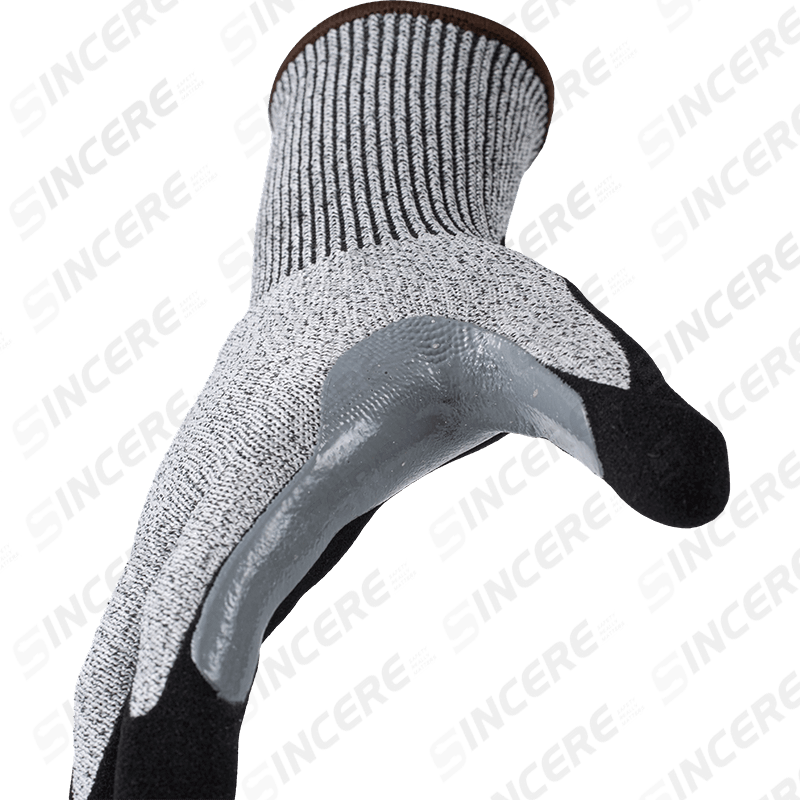 13 Gauge ANSI A4 Nitrile Sandy Palm Cut GlovesThese 13-gauge ANSI A4 gloves pair an HPPE liner with a nitrile sandy palm and extra-long reinforced thumb crotch for sheet metal and glass handling.View Product →
Buyers often ask whether A4 can replace A5 to save money. Sometimes it can, but only when the cutting force in the task is genuinely moderate. The honest way to decide is to look at what the blade in the task is doing: is it being drawn under pressure, or is the hand simply brushing past an edge? Brushing favors A4. Drawing under load pushes toward A5 and above.
A5: Where Sharp Edges Become Routine
A5 covers 2,200 to 2,999 grams, and it suits tasks where sharp contact is part of every cycle rather than an occasional event. Fabrication with burrs, trimming, cutting cable ties, handling cut profiles and working with heavy plastic sheet all sit comfortably here. A5 builds also have enough material to support additional features without becoming clumsy, which is why this level accommodates adjustable wrist closures, extended cuffs, TPR back-of-hand guards and leather palm options.
A6: Heavy Cut Exposure With Control
A6 raises the requirement to three kilograms of force and above. This is the territory of heavy fabrication, thick sheet handling, demolition-adjacent work, and tasks where a blade or a sharp edge is being pulled with body weight behind it. A6 constructions frequently use higher-performance fiber blends, sometimes with steel or glass reinforcement, and they often pair a reinforced thumb crotch with a heavier palm coating.
The A6 range is also where gauge choice becomes a genuine trade-off. A 13 gauge A6 build is durable and forgiving but noticeably thicker. An 18 gauge A6 build keeps a fine-gauge feel while still holding the rating, which is why fine-gauge heavy-cut styles have become popular in assembly work where operators refused older, stiffer gloves.
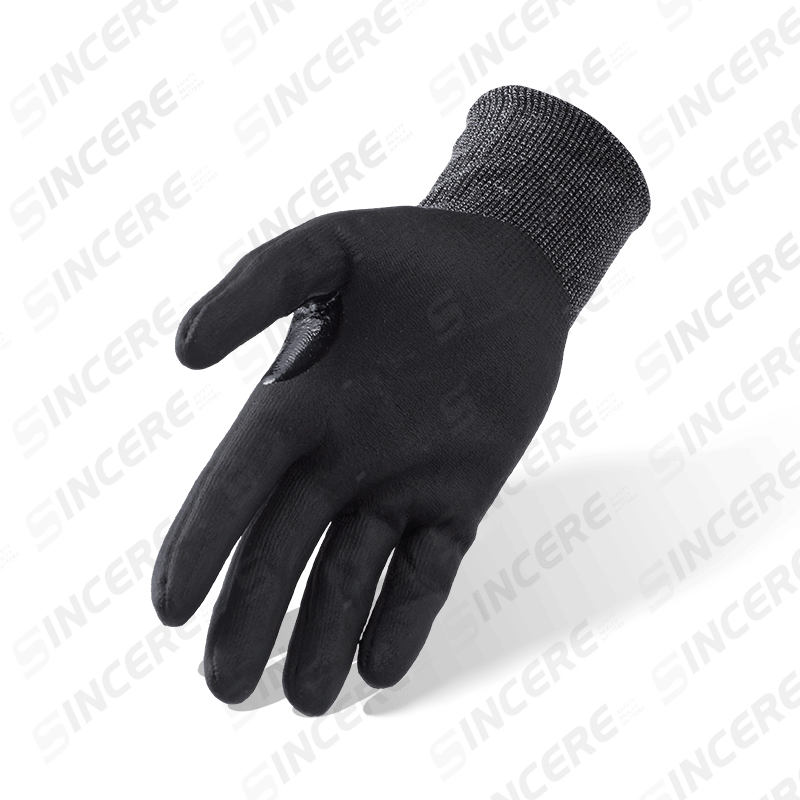 18 Gauge ANSI A6 Nitrile Micro-Foam Cut GlovesThese 18-gauge A6 gloves combine an HPPE liner, nitrile micro-foam palm, and reinforced thumb crotch for heavy cut protection with fine dexterity.View Product →
A7 and A8: High-Force Cutting Environments
A7 and A8 occupy 4,000 to 5,999 grams. These levels exist for environments where the cutting energy is high and the consequences of a failure are severe: heavy metal processing, glass manufacturing, blade handling, and tasks involving large panels or thick materials. Gloves at this level almost always compromise something, whether it is breathability, tactile feedback, weight or cost, and that compromise is the reason they should not be issued to the whole plant.
A common mistake is standardizing everyone on A7 because one workstation needs it. The result is usually a workforce that removes gloves, cuts fingertips off, or wears them only when a supervisor is nearby. Targeted issue works better: the high-force station gets A7 or A8, the adjacent station gets A4, and both groups keep their gloves on.
A9: Maximum Cut Resistance and Its Real Limits
A9 begins at 6,000 grams, which is a very large amount of cutting force, and it is the top of the scale. Constructions at this level typically use dense high-performance blends, stainless steel mesh or full-grain leather palms, and they are built for deliberate contact with severe cut hazards rather than for all-day dexterity work. Stainless steel mesh styles are often chosen for food processing and heavy industrial cutting environments where a blade can meet the hand under pressure.
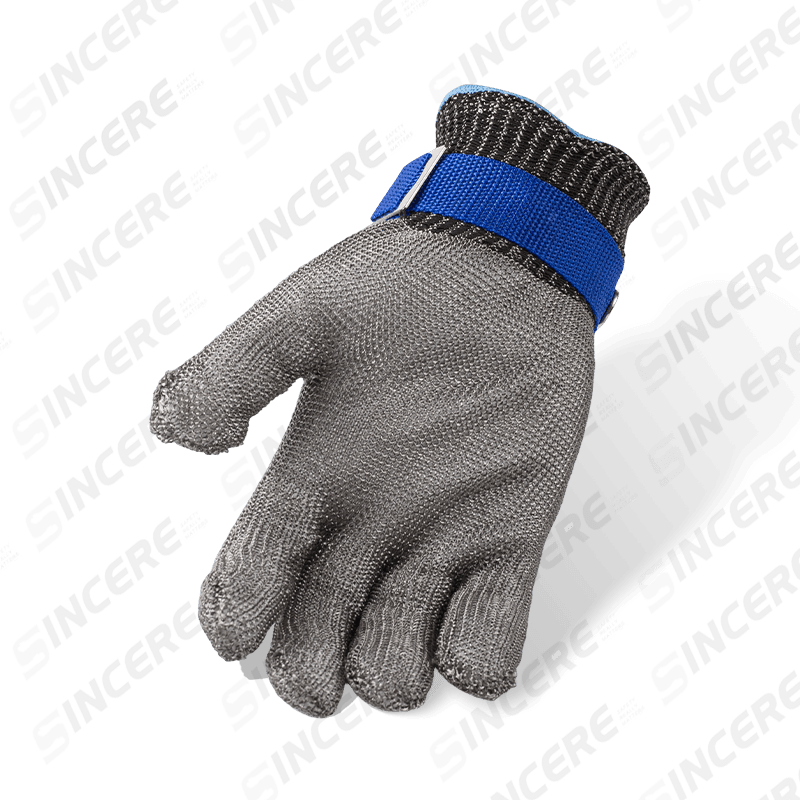 7 Gauge Stainless Steel Mesh ANSI A9 GlovesThese 7-gauge stainless steel mesh gloves meet ANSI A9 and EN388 4X44F for maximum cut protection in meat processing, filleting, and industrial blade handling.View Product →
It is worth saying plainly that A9 is not a license to skip guarding. A glove tested at 6,000 grams resists a blade under controlled conditions; it does not resist a powered saw, a falling knife or a machine that keeps pulling. Cut levels and machine guarding solve different halves of the same problem, and a glove should be the last line rather than the plan.
A Visual Comparison of the Nine Cut Levels
The bar chart below shows the same information as the table in a form that is easier to read at a glance. The bars are proportional to the lower boundary of each level, so the jump from A1 to A4 looks modest while the jump from A6 to A9 looks dramatic. That shape is useful, because it mirrors how protection scales: the first few levels buy a lot of useful coverage for very little loss of feel, and the last few levels buy a narrow band of extra resistance at a significant cost in dexterity and weight.
Reading the chart the other way is just as useful. If a task sits clearly inside A3, buying A6 does not add proportional protection, it adds weight, heat and cost. If a task sits at the top of A4 and the blade is being pulled, buying A3 is not a small saving, it is a gap. The value of the chart is that it makes the gap visible before someone discovers it the hard way, which is the theme explored in our earlier note on whether cut resistant gloves really work and which level a task needs.
ANSI A1–A9 and EN388 A–F: Two Scales, One Idea
European and international buyers often work with EN388, now aligned with EN ISO 13997, which reports cut resistance using the letters A to F. The two systems are not identical, but they are close enough in method that a rough correspondence exists. Both rely on a straight blade under a controlled load, and both express the result as a force rather than as a fabric property. The older EN388 coupe test, with its rotating circular blade and levels 1 to 5, still appears on some gloves, and it behaves quite differently because a rotating blade dulls and blunts in a way a straight blade does not.
| ANSI level | Approximate EN388 TDM letter | What changes in practice |
|---|---|---|
| A1 | A | Light contact, thin liner, maximum feel |
| A2 | A to B | General handling, light coatings |
| A3 | B to C | Entry-level industrial cut protection |
| A4 | C to D | Mainstream industrial protection |
| A5 | D | Frequent sharp-edge contact |
| A6 | D to E | Heavy cut exposure, thicker builds |
| A7 | E | High-force cutting, reduced feel |
| A8 | E to F | Severe cut risk, specialist use |
| A9 | F and above | Maximum resistance, mesh and leather builds |
The correspondence is a convenience, not a conversion table. A test result is a physical measurement, and physical measurements do not translate perfectly between methods, sample preparation routines or laboratories. If a purchase decision depends on a specific number, ask for the test report for that exact style rather than accepting a cross-reference. The letter on one glove and the number on another may describe very similar protection, but they were produced by different procedures and cannot be treated as interchangeable proof.
What does transfer between the systems is the way of thinking. Both scales reward matching, not maximizing. Both put the most useful industrial coverage in the middle. Both make the highest grades specialist tools rather than default choices. Once a buyer understands A1 to A9, the EN388 letters become readable almost immediately, and vice versa.
Why the Highest Cut Level Is Usually the Wrong Default
There is a natural instinct to solve a cut risk by buying the strongest glove available and issuing it to everyone. In practice, that approach fails more often than it succeeds, and it fails for reasons that have nothing to do with the glove's quality. A glove that is heavier, stiffer and warmer than the task requires will be removed, modified, hung on a machine or worn incorrectly, and every one of those outcomes removes protection entirely.
- Dexterity loss slows work, and slower hands near sharp edges spend longer in the risk zone.
- Thicker palms reduce grip feedback, which increases dropped parts, pinch points and hand repositioning.
- Higher cut resistance usually means less breathability, and heat buildup drives glove removal.
- Cost per pair rises, which tempts buyers to extend replacement intervals past the point of safety.
- Cut resistance does not include abrasion, puncture, heat or grip, so a high number can hide a weak area.
- Over-specified gloves invite false confidence, and false confidence is more dangerous than a modest glove used correctly.
A better default is to identify the level that matches the task, then improve the construction around it. An A4 glove with a reinforced thumb crotch, a secure wrist and a palm coating that holds oil will outperform a plain A6 glove in the same job, because it survives longer and stays on the hand. The level sets the ceiling of protection; the construction determines how much of that protection is actually available at the end of a shift.
There is also an economic argument that safety committees rarely put on paper. Replacing an A6 glove every four days costs more than replacing a well-built A4 glove every eight days, and the second option produces fewer hand complaints, less sweat and better task times. Protection per dollar is a real metric, and it usually points at the middle of the scale rather than the top.
Gauge, Fiber and Coating: What Actually Moves the Number
Gauge Sets the Feel
Gauge describes how many needles per inch the knitting machine uses, and it is the single biggest influence on how a glove feels. A 7 gauge liner is coarse, thick and durable, suited to heavy handling and leather-palm constructions. A 13 gauge liner is the industrial standard: substantial enough for coating adhesion and abrasion life, fine enough for general work. A 15 gauge liner is noticeably suppler. An 18 gauge liner feels almost like a second skin and supports fine assembly. A 21 gauge liner is ultrafine, built for precision work where operators would otherwise work bare-handed, and it is the hardest to produce consistently because the yarns are extremely fine and the needles are closely spaced.
Here is the part buyers underestimate: gauge and cut level are independent variables. You can build an A4 glove at 13 gauge or at 21 gauge, and both will pass. What changes is everything else. The 21 gauge version will feel extraordinary and wear faster at the palm. The 13 gauge version will last longer and feel like work gloves. Choosing between them is a decision about the task, not about the rating.
Fiber Sets the Ceiling
Cut resistance comes from the material that meets the blade. High-performance polyethylene, often called HPPE, offers an excellent balance of cut resistance and low weight and is the backbone of most A3 to A6 builds. Aramid fibers bring heat resistance and flame resistance alongside cut performance, which is why aramid styles appear where hot parts and sharp edges occur together. Glass fiber is used in blends to raise cut resistance economically, though it can feel scratchy against the skin, so it is normally placed in the core rather than on the inside surface. Steel wire and stainless steel mesh deliver very high resistance at the top of the scale, and they bring weight, stiffness and a specific feel that suits deliberate high-risk handling.
Blending is where the craft sits. Two fibers can cover each other's weaknesses: one adds cut resistance, another adds softness, a third adds heat tolerance or dimensional stability. A well-blended A4 can feel better than a poorly blended A6, and it can hold its rating after ten washes while the cheaper build drifts downward as the coating degrades and the fibers relax.
Coating Sets the Grip and the Surface
The coating is the part of the glove that touches the world, and it decides whether the glove is usable in that world. Nitrile in a sandy finish provides dry and oily grip with strong abrasion life, which is why it dominates metal handling. Nitrile microfoam gives a softer, spongier touch and better breathability, which suits precision assembly and handling of smooth parts. Polyurethane is thin, flexible and highly tactile, which makes it the natural partner for fine-gauge liners in electronics and cleanroom work. Latex crinkle offers excellent wet grip. Silicone handles heat and offers a clean, non-marking contact surface. Neoprene resists oils and chemicals and pairs well with aramid liners.
Full dip, three-quarter dip and palm-only dip are not cosmetic differences. A palm-only dip leaves the back open and breathable, which keeps hands cooler during continuous work. A three-quarter dip protects the knuckles from abrasion and splash and adds durability in that zone. A full dip creates a barrier against liquids, oils and some chemicals, and it also traps heat, which is why winter waterproof styles use a fleece liner to manage the moisture and temperature.
Reinforcement Decides How Long the Rating Survives
A cut rating is measured on new material. On the job, the palm and thumb crotch wear first, and once the coating is worn through, the tested surface is gone even though the glove is technically still intact. Reinforced thumb crotches, full-thumb reinforcement, extended cuffs and abrasion-resistant palm overcoats exist for exactly this reason. They do not raise the cut level, but they keep the cut level present for longer, which is often worth more than a single step up the scale.
A Five-Step Method for Choosing a Cut Level
The method below is the one we walk through with buyers who are not sure where to start. It takes about twenty minutes in the plant and it prevents most of the expensive mistakes.
- Identify the blade or edge type. Write down what the hand actually meets: a trimmed metal edge, a glass rim, a cutting blade, a wire, a plastic flash line or a rotating tool. The shape of the hazard matters more than the industry name.
- Judge the force behind the contact. Is the hand brushing an edge, pressing a part against an edge, or pulling a tool toward the palm with body weight? Light contact belongs at A2 to A3, moderate pressure at A4, sustained pressure at A5 to A6, and high-force contact at A7 and above.
- Check the contact duration and frequency. A single sharp moment per shift and a sharp edge in every cycle are completely different problems. Frequency pushes the choice up one level even when the force is moderate.
- List the other hazards present. Oil, water, heat, cold, impact, static, cut and abrasion rarely arrive alone. A glove has to manage the combination, because a cut-resistant glove with no grip in oil will fail in a different way.
- Test a candidate on the line, not in the office. Issue a small batch, ask specific questions after two shifts, and check the wear pattern on returned pairs. Where the coating fails first tells you more than any specification sheet.
Step five is the one people skip. A glove trial that runs for a single afternoon produces opinions about comfort; a trial that runs for two weeks produces data about durability. We ask trial users to return used pairs so we can see where the palm wore through, whether the thumb crotch opened, whether the cuff frayed and whether the fit held after washing. Those observations often redirect the choice to a different level entirely, and occasionally they confirm that the original choice was right, which is just as valuable.
It also helps to write the decision down. A short internal note that says "press line 3 handles 0.8 mm steel with burrs, moderate pressure, oil present, A4 nitrile sandy with reinforced thumb crotch, reviewed each quarter" protects the next person who inherits the purchasing decision. Cut levels get lost in staff turnover more often than they get lost in production.
Matching Levels to Everyday Work Situations
The table below is not a standard and should not be treated as one. It is a starting orientation built from the tasks our customers describe most often, and the right answer will still depend on the specific edge, the force and the duration in each workplace.
| Work situation | Sensible starting level | Reasoning |
|---|---|---|
| Warehouse picking, cartons, stretch film | A1 to A2 | Low cutting energy, high need for feel and speed |
| General assembly, small components | A2 to A3 | Occasional sharp edges, fingertip precision required |
| Light sheet metal, panels, ductwork | A3 to A4 | Folded edges and burrs under moderate pressure |
| Stamped parts, trim removal, packaging strapping | A4 | Frequent sharp contact with oil and abrasion |
| Heavy fabrication, burred profiles, cable | A5 | Sharp contact in every cycle, force behind the edge |
| Thick sheet, demolition, blade handling | A6 to A7 | High force, high consequence, reduced dexterity accepted |
| Glass manufacturing, large panels | A5 to A8 | Depends entirely on edge condition and handling method |
| Food processing with knives and blades | A6 to A9 | Deliberate blade contact, mesh and leather often used |
Two patterns appear again and again. The first is that the same job title can sit at different levels in different plants, because the edge condition differs: a glass plant that checks and dresses its edges every shift may run one level lower than a plant that does not. The second is that the level often changes within a single shift. The same operator who handles clean panels in the morning may handle cut scrap in the afternoon. In those cases, two glove types in the same locker are more effective than one compromise glove that is slightly wrong for both halves of the day.
Our own cut resistant glove range is organized around this reality. Levels A3 to A9 share the same underlying logic of gauge, fiber, coating and reinforcement, so a plant can standardize on a family of styles and vary only the properties that matter for each station, rather than mixing unrelated products that fit and wear differently.
Misunderstandings That Lead to the Wrong Glove
- "Higher is safer." Higher is more resistant to a blade, but it is not safer overall if it is removed, if it reduces grip, or if it hides the need for guarding.
- "The number covers the whole glove." The rating comes from a palm sample. Cuffs, backs and seams are not tested to the same level and are not the same barrier.
- "Cut gloves are puncture gloves." Cut resistance and puncture resistance are separate classifications with separate test methods. A blade sliding is not the same as a nail pushing.
- "One level fits the whole plant." Most plants need two or three levels, issued by station rather than by job title.
- "A glove lasts until it tears." A cut glove usually loses its protection long before it fails visibly, because the coating wears through and the tested surface disappears.
- "Thicker means tougher." Thickness and cut level correlate loosely at best. A fine-gauge A6 can outperform a thick A3 easily.
- "Washing does not matter." Cleaning method affects coating integrity, fiber relaxation and fit, and repeated improper washing quietly reduces the protection you paid for.
The most expensive misunderstanding is the last one, because it is invisible. A glove that tested at A4 on day one and is still being worn in week six may be providing A2-level protection at the palm after the coating has worn through and the fibers have abraded. That is why replacement schedules based on observed wear points beat schedules based on calendar dates, and why a glove program that never looks at returned pairs is only guessing.
Care, Inspection and the Signals That Say Replace
Cut-resistant gloves are durable, but they are not permanent, and the rating does not renew itself. Incoming inspection catches manufacturing defects; daily inspection catches real-world degradation. Neither takes more than a few seconds per pair.
What to Check Before Each Shift
- Palm coating worn through to the liner, especially at the base of the fingers and the thumb crotch.
- Glossy, hardened or cracked coating, which signals heat or chemical damage.
- Broken or pulled yarns on the back, which reduce structural integrity even if the palm looks fine.
- Thumb crotch separation or stitch failure, the most common early failure point on reinforced styles.
- Cuff fraying or a stretched wrist, which lets debris in and lets the glove rotate on the hand.
- Stiffness or shrinkage after washing, which changes fit and reduces dexterity.
- Contamination from oils, solvents or metal dust that cannot be removed by normal cleaning.
Cleaning Without Destroying the Rating
Most knitted cut-resistant gloves tolerate gentle machine washing at a moderate temperature with a mild detergent, followed by air drying away from direct heat. What damages them is heat and chemistry: tumble drying, hot radiators, chlorine bleach and strong solvents all attack the coating and the fiber. Leather-palm styles should be cleaned and dried carefully and treated as a different category entirely. When a glove is used with chemicals, the chemical resistance of the coating, not the cut level, is the deciding property, and a glove that passed A4 in a dry state may behave very differently after absorbing a solvent.
Replacement Rhythm
A useful habit is to record where pairs fail. If gloves consistently fail at the thumb crotch, a reinforced style pays for itself quickly. If they fail at the fingertips, the coating thickness or the gauge needs attention. If they fail evenly across the palm, the replacement interval is probably too long. Tracking failure location turns glove purchasing from an annual guess into a controllable process, and it gives a safety team evidence when budgets are reviewed.
Very few cutting tasks are only cutting tasks. The glove also has to handle impact, heat, cold, oil, water, static or the need for a clean contact surface, and the way those requirements combine changes which construction makes sense. A few pairings come up so often that they are worth naming.
Cut Plus Impact
Where parts are heavy and hands work near metal structures, back-of-hand TPR guards protect against knocks and pinches. The guard does not change the cut level, but it changes the glove's weight, its fit and its heat retention, so it should be issued only where impact is a real risk. Adding guards to every glove in a plant usually produces complaints and little benefit.
Cut Plus Heat
Aramid liners bring flame resistance and heat tolerance alongside cut resistance, which suits foundries, welding support tasks and hot-part handling where sharp edges are present. Silicone coatings add a further layer by resisting high surface temperatures and leaving no marks on hot components. The key detail is that heat resistance is rated separately from cut resistance, and one does not imply the other.
Cut Plus Cold and Wet
Winter cut protection needs a liner that insulates without soaking the hand. Acrylic and fleece liners with a full nitrile dip create a waterproof barrier and retain warmth, while a sandy palm keeps grip on wet or icy parts. These gloves are heavier by nature, so they suit outdoor and cold-store work rather than precision assembly.
Cut Plus Precision and Cleanliness
In electronics and cleanroom environments, the glove has to protect a component as much as the hand. Carbon-fiber liners control static, PU coatings leave minimal residue, and 18 or 21 gauge constructions preserve the feel needed for small parts. These environments are where the lowest practical cut level usually wins, because a heavier glove would not be worn for the required tasks anyway.
Cut Plus Food Contact
Food processing adds hygiene requirements that narrow the options considerably. Stainless steel mesh and full-grain leather builds at the top of the scale are common where knives are used under pressure, while lighter nitrile-coated styles handle general food handling. Cleaning and drying routines matter as much as the rating, because a glove that cannot be cleaned properly is not a safe glove regardless of its cut level.
Questions We Hear Most Often
Is A9 the safest glove I can buy?
It is the most cut resistant glove on the ANSI scale, which is not the same thing. Safety depends on whether the glove is worn, whether it fits, whether it grips the part and whether it lasts. A well-fitted A4 that stays on the hand all shift is a safer outcome than an A9 that sits in a locker because it is uncomfortable.
Can I compare an A4 glove from one supplier with an A4 glove from another?
You can compare the level, because the level is defined by the standard. You cannot assume the gloves behave the same, because gauge, fiber blend, coating, fit and durability differ. Two A4 gloves can feel completely different on the hand within the first hour and can wear out at noticeably different rates.
Does a higher gauge mean lower cut resistance?
No. Gauge describes fineness, not protection. An 18 gauge A6 glove exists and performs at A6, while a 13 gauge A3 glove performs at A3. Higher gauge generally improves dexterity and reduces abrasion life, but the cut level is determined by the fiber blend and construction as tested.
How often should cut-resistant gloves be replaced?
By condition, not by calendar. Check the palm coating, the thumb crotch, the yarn integrity, the cuff and the fit at the start of every shift. Replace when the coating is worn through, when yarns are broken, when the glove no longer fits securely, or when contamination cannot be removed. A written replacement trigger is far more effective than a fixed interval.
Do cut-resistant gloves work with touchscreens?
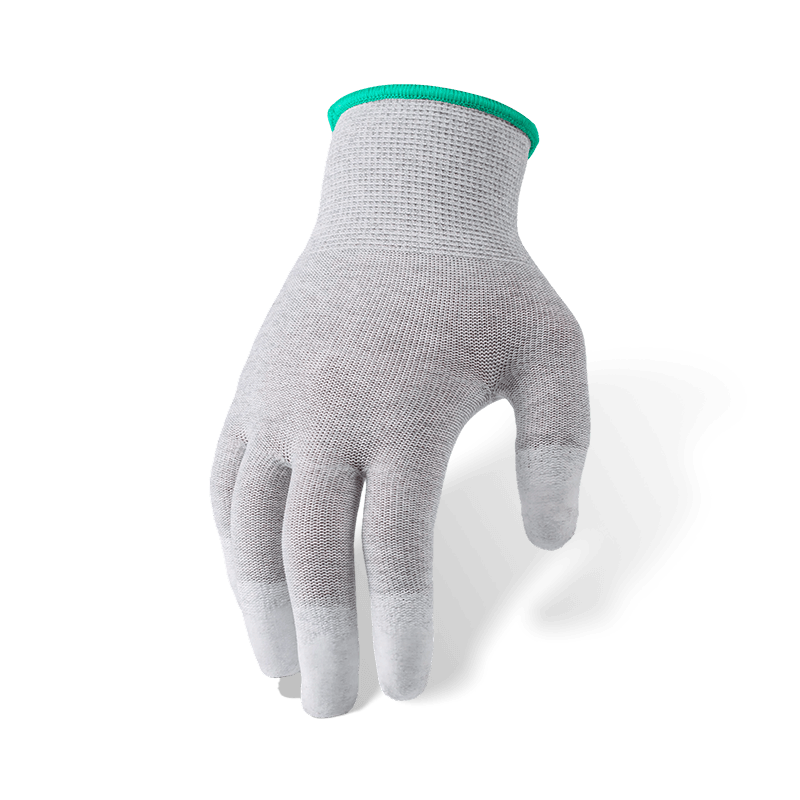
Some do. Conductive fingertips are available on certain fine-gauge styles, and they are useful in warehouses and assembly lines where handheld terminals are used. The conductive feature does not affect the cut level, but it does add a component that wears, so check that the fingertips remain functional as part of routine inspection.
What information should I ask a supplier for?
Ask for the tested level of the exact style, the test method and standard version referenced, the gauge and fiber blend, the coating type and coverage, and the available sizes. Ask how the style behaves after washing. A supplier who can answer those questions without hesitation is telling you something about the consistency of the product as well as the glove itself.
The most useful habit in cut protection is comparison. Keep one pair of each level your plant uses, compare them on the hand, compare them after two weeks of work, and compare what they cost per shift rather than per pair. Levels A1 to A9 are the vocabulary, not the answer, and the plants that get cut injuries down are the ones that keep testing the vocabulary against what their own work actually does to a glove.

LEVERAGE OUR INNOVATIVE YARN TECHNOLOGY TO UNLOCK NEW MARKET POTENTIAL FOR YOUR BRAND.
Start Your Custom ConsultationCopyright © Nantong Sincere Safety Products and Technology Co., Ltd. All Rights Reserved
