

 English
 Français
 Español
 Deutsch
 Português
 عربى


/SINCERE
contact information
info@sinceresafety.com
+86-190 5138 6834
High Tech industrial Park, Rudong County, Nantong City, Jiangsu Province, China.
-

WhatsApp
-

WeChat
-

Mobile

/Trends

Nitrile vs PU vs Latex Coated Gloves: Which Coating Is Best for Which Job
20 Nov 26
Content
- 1 What the Coating Really Does on a Knitted Work Glove
- 2 Nitrile Coated Gloves: Oil, Abrasion, and Heavy Handling
- 3 PU Coated Gloves: Precision, Touch, and Clean Work
- 4 Latex Coated Gloves: Grip, Flexibility, and Cost
- 5 Nitrile vs PU vs Latex: Side-by-Side Comparison
- 6 Palm Dip, Full Dip, and 3/4 Dip: How Coverage Changes the Job
- 7 Matching the Coating to Specific Jobs
- 8 Gauge and Liner Material: What Sits Under the Coating
- 9 Comfort, Sweat, and How Long the Glove Stays On
- 10 Durability, Test Ratings, and What the Label Means
- 11 Customizing Coated Work Gloves for a Specific Job
- 12 Common Mistakes When Choosing a Coated Glove
What the Coating Really Does on a Knitted Work Glove
A coated work glove is a two-part product. The liner is knitted from nylon, polyester, cotton, HPPE, or a blend of these, and it decides fit, breathability, and how the glove feels against the skin. The coating is a polymer applied to the palm, the fingers, or the whole hand, and it decides grip, abrasion resistance, liquid resistance, and how the glove behaves when it meets oil, water, heat, or sharp edges.
The three coatings that come up most often in industrial hand protection are nitrile, polyurethane (PU), and latex. They behave differently enough that the same task can feel comfortable with one coating and frustrating with another. A machine shop running coolant lines all day will keep a nitrile-coated glove on through the shift. An electronics assembler handling small components will reach for a PU glove because it preserves fingertip sensitivity. A landscaping crew working through wet brush usually prefers latex for its wet grip and lower replacement cost.
So the practical framing is simple: none of the three coatings is best overall. Each one is best matched to a job. The rest of this guide walks through how each coating performs, where it fails, and which tasks sit squarely inside its strengths.
Nitrile Coated Gloves: Oil, Abrasion, and Heavy Handling
Nitrile is a synthetic rubber that cures into a dense, tough surface. On a coated glove it appears in several finishes: smooth, sandy (rough textured), microfoam (open-cell foam), and water-washed. Each finish changes how the glove holds a dry part, an oily part, or a wet part.
The defining advantage is resistance to oil and grease. Latex and PU gloves that soften or degrade when they meet mineral oil, motor oil, coolant, or grease keep their shape when made with nitrile. That is why machining shops, automotive repair, metal fabrication, and any operation that handles oily parts usually default to nitrile.
Abrasion resistance is the second advantage. Nitrile-coated gloves usually reach high or very high abrasion ratings, which means the coating survives a large number of cycles in a controlled laboratory test and, in practice, survives rough cardboard, metal burrs, and repeated handling wear.
The limit of nitrile is touch. Smooth nitrile can feel slippery and reduces fingertip sensitivity. Sandy or microfoam nitrile recovers some grip, but it will not match PU for tactile feedback or flexibility. For assembling small parts or picking tiny components out of a bin, nitrile over-delivers for that specific task.
A typical nitrile-coated glove might use a 13 or 15 gauge polyester or nylon liner with a sandy nitrile palm dip. That combination balances dexterity with durability. Where the job involves oil and sharp edges at the same time, nitrile on a cut-resistant liner solves both problems in one glove. We produce these as part of our coating and treatment range, with palm dips, 3/4 dips, and full dips depending on how much liquid protection the wearer actually needs.
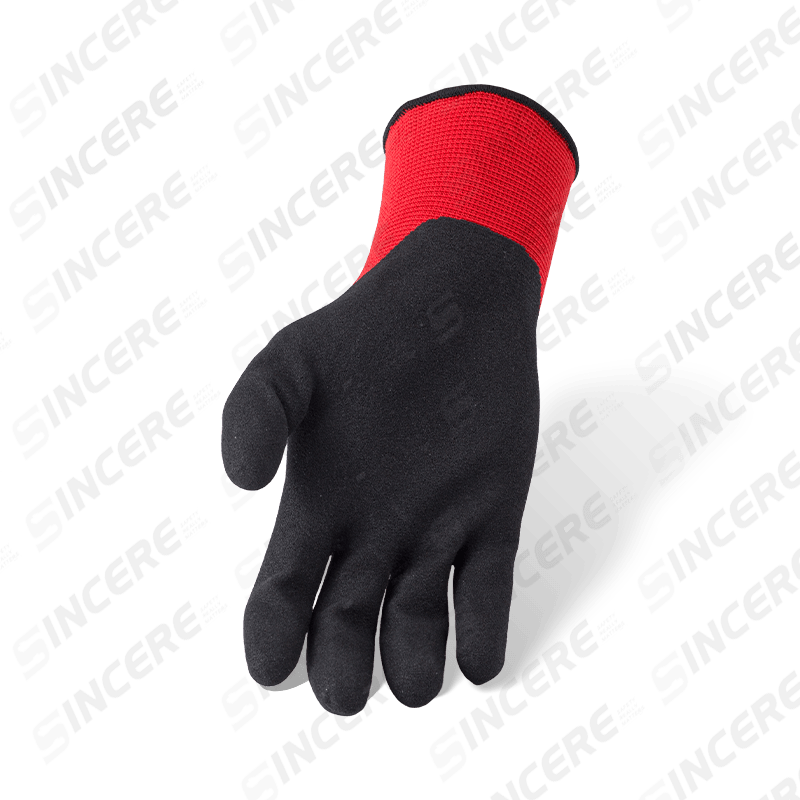 13 Gauge Polyester Sandy Nitrile Palm Coated Work GlovesRed polyester liner and black sandy nitrile palm offer a dependable non-slip grip for general assembly, material handling, warehousing and light maintenance tasks.View Product →
Nitrile also handles heat better than latex in some formulations, and it works well with extended cuffs on gloves that need to keep splashes off the forearm. For a workshop that cycles between dry parts and oily parts, sandy nitrile on a 15 gauge nylon liner is often the most practical single glove to keep on the rack.
PU Coated Gloves: Precision, Touch, and Clean Work
Polyurethane is a light, highly elastic polymer. On a glove it usually appears as a thin palm dip or a finger dip. The thinness is the point. A PU glove fits close and lets the wearer feel small parts, read fine markings, and pick up tools with very little force.
PU shines in dexterity and dry precision grip. Electronics assembly, light assembly, inspection, packaging small components, cleanroom handling, and touchscreen-compatible tasks all sit in its wheelhouse. A second advantage is breathability. Because the PU coating is thinner and more open than nitrile or latex, the wearer tends to feel cooler and can keep the glove on for hours at a time.
The limits are just as clear. PU is not a heavy oil or chemical barrier. PU coatings degrade under prolonged contact with oils, greases, and many solvents. In a heavily oiled environment, a PU glove will swell, blister, or lose grip. It is also not the best choice for wet or heavy-duty handling. PU gloves do their best work in dry, clean, precision environments.
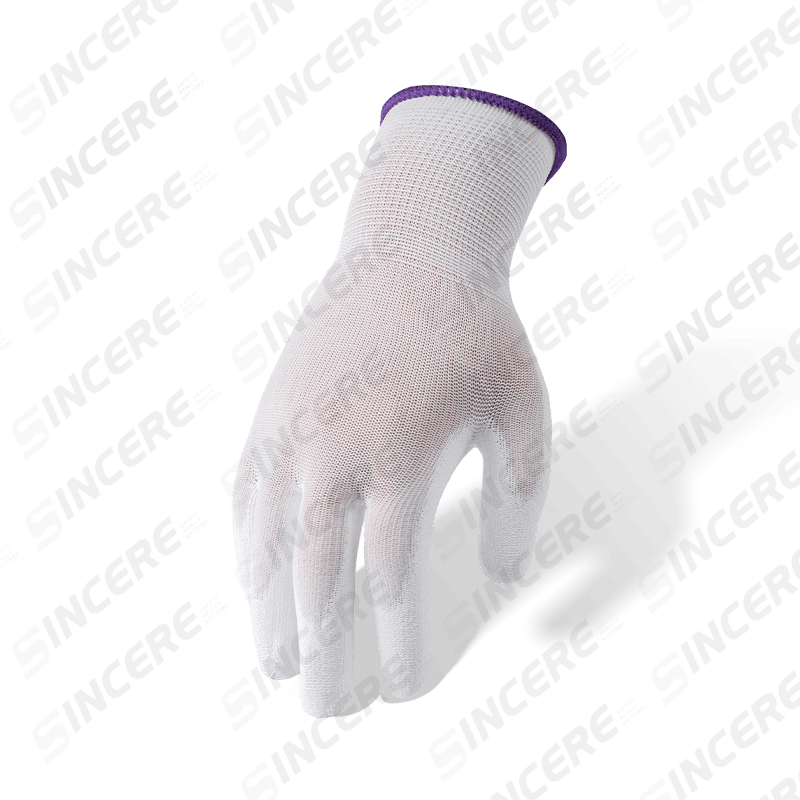
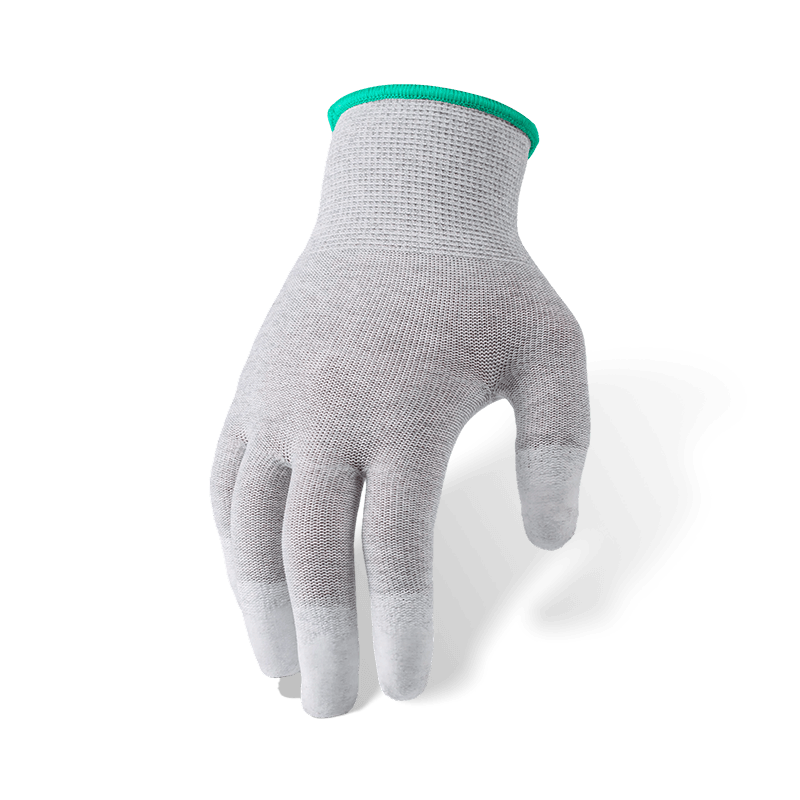
A useful variation is the carbon-fiber liner with a PU fingertip coating, used for ESD-sensitive or cleanroom work. The carbon fiber provides a controlled static-dissipative path, and the thin PU coating preserves touch while giving just enough grip. White nylon with a white PU palm coating is another common cleanroom option, because the pale color makes contamination easier to spot.
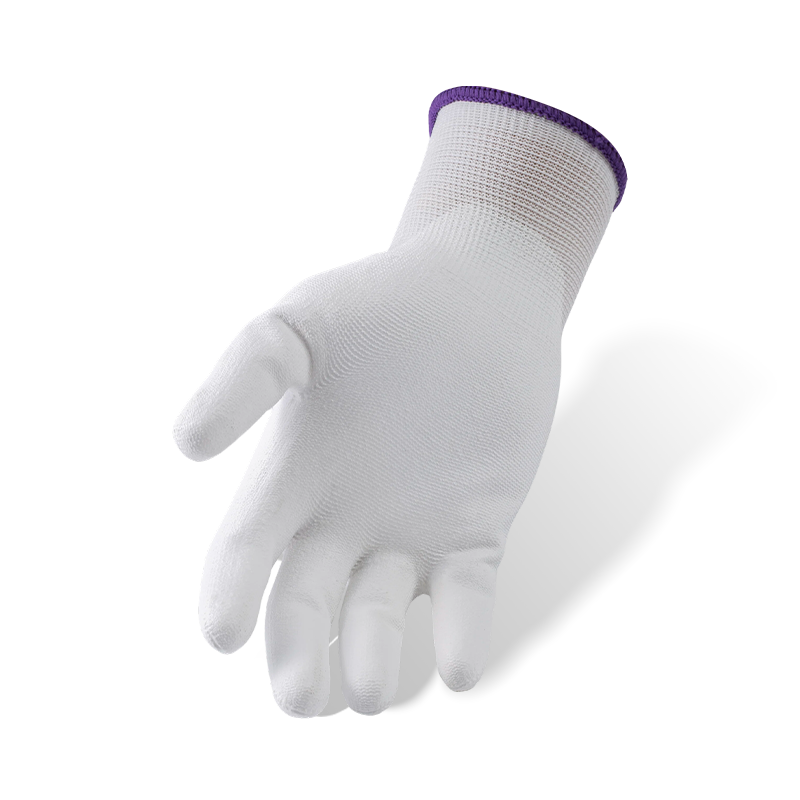 13 Gauge White Nylon PU Palm Cleanroom GlovesWhite nylon liner and white PU palm support precise handling and contamination visibility in cleanroom, pharmaceutical, food processing and detailed assembly work.View Product →
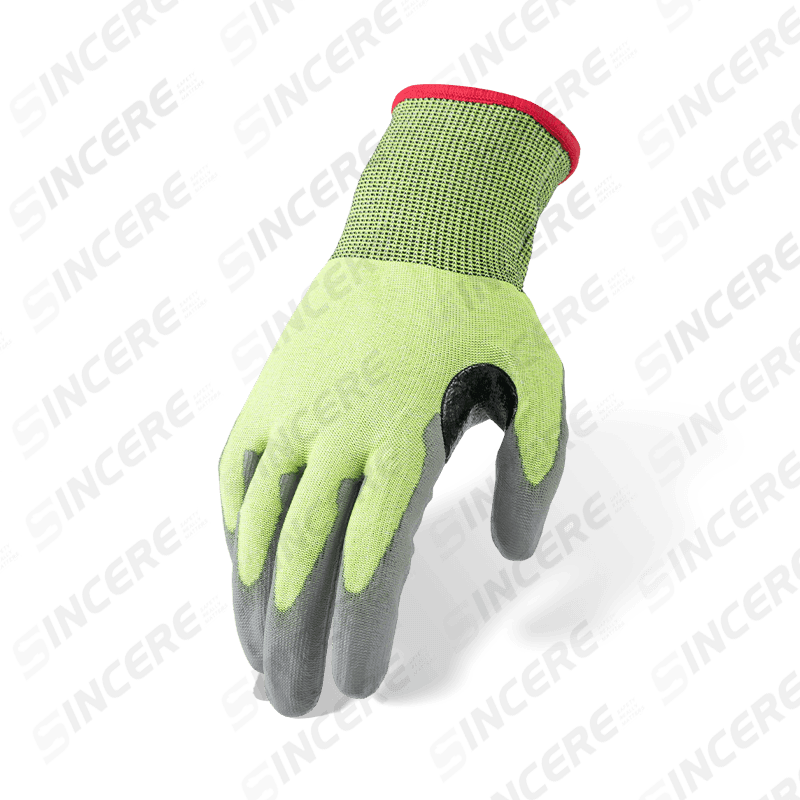
For tasks that mix light handling with a lot of part picking, a 13 gauge grey nylon liner with a grey PU palm is a practical compromise: it keeps the tactile feel of PU while adding a bit of surface texture that resists slipping on smooth parts.
Latex Coated Gloves: Grip, Flexibility, and Cost
Latex is a natural rubber drawn from rubber trees, and it is the oldest of the three coatings. It comes in several finishes: crinkle, foam, smooth, and sandy. Crinkle latex delivers outstanding wet grip because the raised wrinkles act like miniature treads that channel water away. Foam latex adds softness and flexibility while keeping good grip.
Latex excels in wet grip and does well in dry conditions too. Construction, landscaping, lumber handling, brick and tile handling, and any outdoor job that involves grabbing wet or dusty objects are classic examples. Flexibility is another advantage: latex bends with the hand more naturally, without the stiffness that nitrile sometimes produces. Latex is also usually the cheapest of the three coatings when you compare cost per pair.
The trouble appears when latex meets oil, grease, and some chemicals. Natural latex degrades in those environments, loses its elasticity, and can fail in a place like a machine shop. Latex also has a potential allergy issue. Natural rubber latex allergy affects a small share of workers, and some workplaces now avoid latex gloves because of it. For those workplaces, nitrile is the go-to replacement.
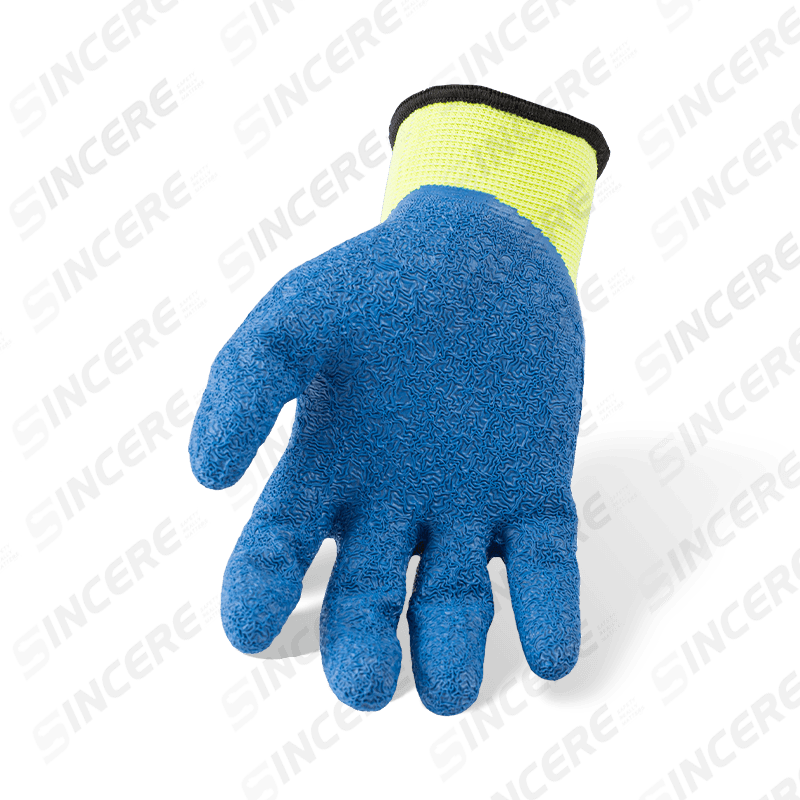 13 Gauge Polyester Crinkle Latex 3/4 Dipped Work GlovesHi-vis yellow polyester liner with crinkled latex 3/4 dip provides aggressive wet and dry grip for construction, road work, landscaping and general outdoor handling.View Product →
On a budget, a 13 gauge polyester liner with crinkle latex and a 3/4 dip covers a lot of general outdoor work. The hi-vis yellow version adds daytime visibility for road crews and site work, which is a small thing that quietly improves safety on a busy site.
Nitrile vs PU vs Latex: Side-by-Side Comparison
The table below pulls the main performance traits together so the trade-offs are visible at a glance. It is worth reading in combination with the job scenarios that follow, because no single row tells the whole story.
| Performance trait | Nitrile | PU | Latex |
|---|---|---|---|
| Oil and grease resistance | Excellent | Poor | Poor |
| Abrasion resistance | High to very high | Moderate | High |
| Tactile sensitivity | Moderate | Very high | Moderate to low |
| Dry grip | Good (sandy or microfoam) | Excellent | Good |
| Wet grip | Moderate | Low | Excellent (crinkle) |
| Breathability | Moderate | High | Low |
| Chemical resistance | Good | Limited | Limited |
| Relative cost | Moderate to high | Moderate | Low |
| Best-fit tasks | Oily metal, machining, automotive, heavy handling | Electronics, assembly, inspection, cleanroom | Construction, landscaping, wet or dusty outdoor work |
What the table does not show is how much a specific job changes the weighting. A single oily bolt can rule out PU for an entire assembly line. A wet morning can turn a latex glove into the only sensible choice for a landscape crew. The comparison should be read as a starting filter, not a final answer.
Palm Dip, Full Dip, and 3/4 Dip: How Coverage Changes the Job
The coating material is only half the decision. The other half is how much of the hand the coating covers. Coverage decides breathability, liquid protection, and how quickly the glove dries between uses.
| Coverage style | Covered area | Typical use |
|---|---|---|
| Palm dip | Palm and fingers only | Dry precision work, high flexibility, good breathability |
| 3/4 dip | Palm, fingers, and part of the back of the hand | Wet or oily work where some splash protection helps |
| Full dip | Entire hand | Liquid, chemical, or heavy oil exposures |
| Dotted palm | Pattern of dots on palm and fingers | Light grip work in dry conditions, good airflow |
A palm-dipped PU glove is breathable and dexterous, but it offers no protection on the back of the hand. A 3/4 dipped latex glove adds splash coverage while letting the back of the hand breathe. A fully dipped nitrile glove keeps the whole hand dry in wet or oily work, but traps more heat. The right coverage depends on how the wearer's hands actually meet the hazard, not on the coating alone.
The dip pattern also affects how the glove dries overnight. Palm dips dry quickly, full dips dry slowly, and 3/4 dips sit in between. On a site where gloves are rotated daily, that difference influences how many pairs each worker needs.
Matching the Coating to Specific Jobs
The following task-based cards are the fast way to turn the comparison into a decision. Each card names a job family and the coating that handles it best, followed by a short note on what to watch for.
Machining and metal work
Nitrile, usually sandy or microfoam. Coolant, cutting oil, and metal chips sit inside nitrile's strengths. Pair with a cut-resistant liner if sharp edges are present.
Electronics and small parts
PU, palm-dipped. Thin PU keeps fingertip sensitivity and reduces hand fatigue during repeated picking and placing.
Cleanroom and inspection
PU on a white or carbon-fiber liner. Pale colors show contamination, and PU limits particle shedding without blocking touch.
Construction and landscaping
Latex, crinkle finish. Wet grip and flexibility matter more than oil resistance on most outdoor sites, and the cost per pair is low.
Automotive repair
Nitrile, often full dip. Oil, brake fluid, and grease are routine, so oil resistance matters more than breathability.
Food and wet processing
Nitrile or latex depending on the specific standard, with a full or 3/4 dip. Check the current food-contact and allergy requirements before choosing.
Where two coatings both seem plausible, the deciding factor is usually the liquid the glove meets most often. Oil pushes the choice toward nitrile. Water pushes it toward latex. Nothing reactive pushes it toward PU, which is why clean and dry environments favor PU so strongly.
Gauge and Liner Material: What Sits Under the Coating
Two gloves with the same coating can feel completely different, because the liner decides how the glove fits, how thick it feels, and how much cut or heat resistance the finished product carries.
Gauge refers to the number of knitting needles per inch. Higher gauge means a finer knit. A 13 gauge liner is the general-purpose standard. An 18 or 21 gauge liner is noticeably finer, soft, and more dexterous, and it makes a good base for a thin PU dip or a high-dexterity nitrile dip. A 7 or 10 gauge liner is thicker and warmer, and it suits heavier coating layers and cold-weather work.
Liner material shapes the job further. Nylon and polyester are the workhorses for light and general tasks. They accept coatings well and keep cost reasonable. HPPE and fiberglass blends add cut resistance without much weight. Aramid adds heat resistance as well as cut resistance. Cotton and acrylic fleece add warmth for cold storage and winter work. Carbon fiber adds static dissipation for electronics.
The practical result is that a “nitrile glove” is really a whole family of products. A 21 gauge nylon liner with a thin nitrile dip and a 13 gauge polyester liner with a heavy sandy nitrile dip are both nitrile-coated gloves, but they belong in different job categories. Gauge and liner are the first specification to check when two products look similar in a catalog.
The fit of the knit also decides how long the coating lasts. A liner that bunches inside the glove will flex the coating unevenly and wear through at the knuckles and fingertips. A well-knit liner spreads stress across the palm, and the coating keeps its grip longer.
Comfort, Sweat, and How Long the Glove Stays On
Comfort is not a soft benefit in hand protection; it is a compliance driver. A glove that a worker takes off every twenty minutes is not protecting the hand. Coating choice plays a direct role in whether the glove stays on.
PU wins on breathability for dry work. The thin coating lets more air move through the liner, which keeps the hand cooler during light, precise tasks. Nitrile is in the middle: more sealed than PU, less sealed than a full latex dip. Latex is the warmest of the three in a full dip because the coating traps moisture close to the skin.
Full dips also reduce how quickly the glove dries after a wet shift. A palm dip dries overnight on a peg; a full dip may still be damp the next morning. On sites with limited drying space, palm-dipped gloves are easier to keep in rotation.
The liner matters here too. A fine 18 or 21 gauge knit conforms to the hand and reduces bunching, which improves both comfort and coating life. An aramid or fleece liner adds heat or cold insulation but also adds bulk, which is a trade-off the buyer needs to weigh against the actual work temperature.
Durability, Test Ratings, and What the Label Means
Three performance ratings matter most when comparing coated gloves: abrasion, cut, and sometimes impact.
Abrasion ratings run on a rough scale from lower numbers for lighter protection to higher numbers for heavier protection, using standard mechanical testing. A high abrasion rating means the coating survives longer against rough surfaces, which is exactly what nitrile is engineered for. PU tends to score lower on abrasion but higher on dexterity, and that is a fair trade for precision work.
Cut resistance on coated gloves comes from the liner, not the coating. A PU glove on a plain nylon liner offers light cut protection, while a nitrile glove on an HPPE liner can reach a high cut level. Matching the coating to the liquid hazard and the liner to the cut hazard is the way to build a single glove that handles both.
The label should also show the relevant standard for the region where the glove is sold. Buyers who compare gloves from different suppliers should compare the actual test results, not marketing language. Two gloves that both say “high abrasion” can sit at different points within that band.
Coating thickness is the quiet variable. A thicker nitrile layer lasts longer but reduces feel, while a thin PU layer preserves dexterity but wears faster at the fingertips. For a heavy-abrasion job, a thicker nitrile will usually outlast a thin PU by a wide margin. For a touch-sensitive assembly job, the opposite is true.
Customizing Coated Work Gloves for a Specific Job
Off-the-shelf coated gloves cover most general tasks, but some operations need something more specific, and that is where OEM and ODM development earns its place.
Customization can work on several levels. The liner can change gauge, material, and color. The coating can change from nitrile to PU to latex, and the dip pattern can shift from palm to full dip. Extra features such as reinforced thumb crotches, extended cuffs, TPR back-of-hand protection, touchscreen fingertips, or high-visibility liners can be added. Each change affects grip, comfort, durability, and cost, so a custom glove is usually designed with the job in mind rather than from a catalog.
For a company sourcing gloves for a specific operation, it helps to bring three things to the conversation: the liquid the glove meets, the cut or heat level of the work, and the expected handling time per shift. Those three points narrow the coating, the liner, and the dip pattern quickly.
Our coated glove selection notes sit alongside this article for buyers who want a shorter working checklist. The longer version here is meant for teams that need to build a glove specification from the job outward.
Common Mistakes When Choosing a Coated Glove
Choosing by price per pair instead of cost per shift. A cheap latex glove that wears through in three hours costs more than a nitrile glove that lasts a full shift. The cost-per-pair number hides the real number, which is cost per pair divided by the hours of coverage it actually delivers.
Choosing by coating material instead of the job. “We use nitrile” tells nothing about the actual work. Two nitrile gloves from different lines can have very different gauge, liner, dip depth, and coating weight, and those differences decide whether the glove fits the environment.
Ignoring the liner. The liner delivers fit, cut resistance, and heat resistance. A buyer who only reads the coating name will miss the part of the glove doing the quiet work.
Using PU in an oily environment. PU is excellent in dry precision work and a poor choice near oil. The glove often fails at the wrist first, where the coating cracks and curls.
Using latex where a worker has a latex allergy. For any workplace with a known allergy, a nitrile equivalent is the practical alternative, and the right nitrile glove usually matches the latex one for wet grip closely enough.
Choosing a full dip for a wet-shift glove rotation. If the site has nowhere to dry a full dip, a palm dip or 3/4 dip keeps the rotation alive without moisture building up inside the glove.
The simple rule that keeps most decisions clean is this: match the coating to the liquid, the liner to the hazard, and the dip to how much of the hand needs protection. Those three choices cover most of the job, and the rest is fit and comfort, which workers will tell you about in the first week.

LEVERAGE OUR INNOVATIVE YARN TECHNOLOGY TO UNLOCK NEW MARKET POTENTIAL FOR YOUR BRAND.
Start Your Custom ConsultationCopyright © Nantong Sincere Safety Products and Technology Co., Ltd. All Rights Reserved
