

 English
 Français
 Español
 Deutsch
 Português
 عربى



/SINCERE
contact information
info@sinceresafety.com
+86-190 5138 6834
High Tech industrial Park, Rudong County, Nantong City, Jiangsu Province, China.
-

WhatsApp
-

WeChat
-

Mobile

/Trends

Do Cut Resistant Gloves Really Work, and Which Cut Level Do You Need
05 Nov 26
Content
- 1 Quick Answers About Cut Resistant Gloves
- 2 How Cut Resistant Gloves Stop a Blade
- 3 Reading Cut Resistance Standards on a Label
- 4 What Is the Most Cut-Resistant Glove for Your Work?
- 5 Do Cut-Proof Gloves Actually Work?
- 6 What Are Level 5 Cut-Resistant Gloves?
- 7 Can You Get Cut While Wearing Cut-Resistant Gloves?
- 8 Coatings and Palm Finishes on Cut Resistant Gloves
- 9 Cut Resistant Gloves Product Configurations
- 10 Where Different Cut Levels Are Used
- 11 Care, Inspection and Replacement of Cut Resistant Gloves
- 12 Specification Checklist for Cut Resistant Gloves
- 13 Cut Resistant Gloves FAQ
- 13.1 Are cut-resistant gloves also puncture resistant?
- 13.2 Is ANSI A4 enough for handling glass?
- 13.3 What is the difference between the ANSI and EN 388 cut scales?
- 13.4 Can cut-resistant gloves be worn for knife work?
- 13.5 Do thicker gloves always cut better?
- 13.6 How often should Cut Resistant Gloves be replaced?
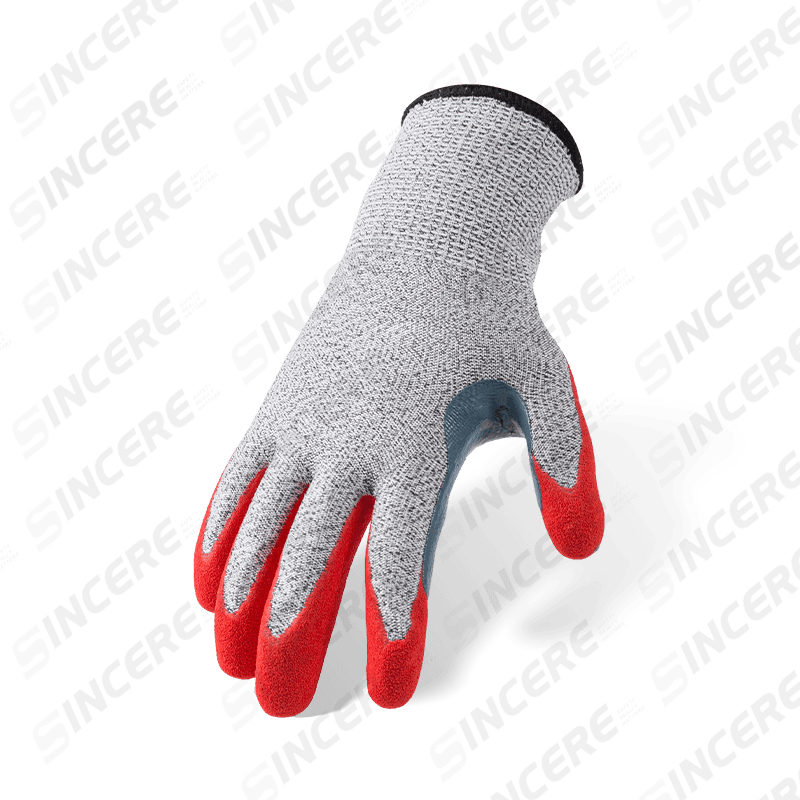
Cut Resistant Gloves protect the hands of workers who handle glass, sheet metal, blades, stamped parts and packaging materials with sharp edges. A pair of Cut Resistant Gloves is rated by standardized blade tests, and the rating tells you how much force or how many blade cycles the fabric can withstand before it is sliced through. This guide answers the questions people ask most often: what is the most cut-resistant glove, do cut-proof gloves actually work, what are level 5 cut-resistant gloves, and can you get cut while wearing cut-resistant gloves.
Quick Answers About Cut Resistant Gloves
What is the most cut-resistant glove?
The highest published level is ANSI/ISEA 105 A9 (6000 grams or more) and EN 388 ISO 13997 level F (30 newtons). Gloves at this level normally combine stainless steel wire with high-performance polyethylene, glass fiber or aramid in a thick 10-gauge or 7-gauge knit.
Do cut-proof gloves actually work?
Cut Resistant Gloves work when the glove level matches the hazard. Laboratory blade tests show that rated fabrics carry far more load than plain cotton or leather. No glove is completely cut-proof, so the correct description is cut resistant, not cut proof.
What are level 5 cut-resistant gloves?
Level 5 can mean ANSI/ISEA 105 A5 (2200 to 2999 grams) or EN 388 Coup test index 5 (index of 20.0 or higher). The two scales use different blades and methods, so the label must name the standard.
Can you get cut while wearing cut-resistant gloves?
Yes. A new razor edge, high pressing force, a puncture, a worn palm, a loose fit or an uncovered wrist can all lead to injury. Cut Resistant Gloves lower the chance and the depth of a cut; they do not remove the hazard.
How Cut Resistant Gloves Stop a Blade
A blade cuts a textile by pushing individual yarns apart and severing them one by one. Cut Resistant Gloves slow this process in two ways. The first is the hardness and toughness of the fiber itself: yarns with high tensile strength and a low elongation resist the edge, and some fibers dull the blade as it travels. The second is the structure of the knit. A dense, uniform loop pattern spreads the load over many yarns at once, so no single strand has to carry the full force of the edge.
Fiber blends matter more than any single material. High-performance polyethylene (HPPE) is light and cool to wear, but it has a low melting point, so it is a poor choice near hot surfaces. Glass fiber is hard and abrasive to blades, though loose filaments can irritate skin when the liner is uncovered, which is why glass fiber is usually wrapped by a softer yarn. Aramid adds heat tolerance and tear strength. Stainless steel wire adds the largest jump in cut level and also the most stiffness.
Gauge describes how many needles are used per inch of the knitting machine. A higher gauge number means finer yarn and a thinner glove with better touch sensitivity; a lower gauge number means heavier yarn and thicker walls. Most Cut Resistant Gloves for light assembly are knitted at 15 or 18 gauge, general handling gloves at 13 gauge, and heavy-duty protection at 10 or 7 gauge.
Fiber Properties in Cut Resistant Gloves
| Fiber | Cut contribution | Comfort | Heat behavior | Typical use in a blend |
| HPPE | Medium to high | Soft, cool, light | Softens near 150 °C, avoid hot contact | Base yarn for A2 to A5 liners |
| Glass fiber | High | Firm, needs a wrapping yarn | Stable at high temperature | Core filament that raises the level |
| Aramid | Medium to high | Medium softness | Flame resistant, does not melt | Heat-exposed handling |
| Stainless steel wire | Very high | Stiffer, heavier | Conducts heat | A6 to A9 knits |
| Nylon or polyester wrap | Low | Smooth, skin-friendly | Moderate | Covers harder fibers for comfort |
| Spandex | None | Stretch and fit | Moderate | Improves contour around fingers |
Reading Cut Resistance Standards on a Label
Two standard families dominate the labels on Cut Resistant Gloves. EN 388 is the European standard for gloves that protect against mechanical risks, and the current version is EN 388:2016+A1:2018. ANSI/ISEA 105 is the North American standard, and it uses the ASTM F2992 test method to rate blade cut. Many gloves carry both marks, but the two systems measure cut in different units, so they should be read side by side and never swapped for each other.
The EN 388 pictogram is followed by a code of four digits, one letter and sometimes a second letter. Each position reports a separate test result. The example below, 4X43F, is a common pattern on gloves built for sharp edges.
A trailing letter P means the glove also passed the impact protection test. The X in the second position appears when the Coup test is not valid for the material, which is common for fabrics that dull the circular blade. In that case the ISO 13997 letter is the trusted cut value.
EN 388 Performance Levels at a Glance
| Level | Abrasion (cycles) | Coup cut (index) | Tear (newtons) | Puncture (newtons) |
| 1 | 100 | 1.2 | 10 | 20 |
| 2 | 500 | 2.5 | 25 | 60 |
| 3 | 2000 | 5.0 | 50 | 100 |
| 4 | 8000 | 10.0 | 75 | 150 |
| 5 | Not rated | 20.0 | Not rated | Not rated |
ANSI/ISEA 105 and EN 388 TDM Cut Levels Compared
| ANSI level | Blade load (grams) | Approx. newtons | EN 388 ISO 13997 letter | Typical exposure |
| A1 | 200 to 499 | 2 to 5 | A | Light materials, paper edges |
| A2 | 500 to 999 | 5 to 10 | B | Packaging, small parts |
| A3 | 1000 to 1499 | 10 to 15 | C | Automotive trim, building materials |
| A4 | 1500 to 2199 | 15 to 22 | D | Stamped metal, oily parts |
| A5 | 2200 to 2999 | 22 to 29 | E | Sheet glass, sharp metal edges |
| A6 | 3000 to 3999 | 29 to 39 | F | Heavy metal fabrication |
| A7 | 4000 to 4999 | 39 to 49 | F | Blade-intensive handling |
| A8 | 5000 to 5999 | 49 to 59 | F | High-risk edge exposure |
| A9 | 6000 and above | 59 and above | F | Extreme edge exposure |
EN 388 stops its TDM scale at F, which begins at 30 newtons. Every ANSI level from A6 to A9 therefore shares the same EN 388 letter. The ANSI scale separates these heavy-duty levels, which is why it gives more useful detail when comparing gloves for the most severe hazards.
ANSI/ISEA 105 Minimum Blade Load by Level
Minimum blade load in grams for each ANSI/ISEA 105 cut level. The curve climbs steeply after A5, which explains the sharp rise in yarn content and glove weight at the upper levels.
EN 388 ISO 13997 Cut Force by Letter
What Is the Most Cut-Resistant Glove for Your Work?
The answer depends on whether the question is about the highest number on a label or the best result on a shop floor. On paper, a knit with stainless steel wire reaching ANSI A9 and EN 388 level F holds the top position. On a shop floor, the best Cut Resistant Gloves are those that stay on the hands for the whole shift. A glove that is too stiff for the task gets pulled off for fine work, and an unprotected hand is the most dangerous outcome of all.
Three questions help locate the right level. How sharp is the edge: a deburred stamping, a fresh utility blade or a broken glass pane? How is the edge met: a light brush while carrying, a sliding pull while stripping material, or a pressing stroke while cutting? How long is the exposure: a few minutes per hour or an entire shift? Short, light contact with a dull edge is well covered by A2 or A3. Sustained sliding contact with sharp metal is a job for A5 to A7. Direct blade work with hand pressure needs A8 or A9 and, in many cases, additional guarding.
Highest cut level
Steel wire blended with HPPE or glass fiber at 7 or 10 gauge. Level A8 to A9 and EN 388 level F. Heaviest and stiffest option, suited to direct blade exposure.
Highest level without steel
Engineered yarn blends of HPPE, glass fiber and aramid at 13 gauge can reach A5 to A6. Lighter and softer than steel-containing knits, with no metal conducting heat.
Highest level with fine touch
15 and 18 gauge knits reach A2 to A4 while keeping the hand sensitive for small parts, screws, connectors and sorting tasks.
Handling Comparison Across Cut Levels
Indicative relative scale for finger dexterity. Actual feel depends on gauge, yarn blend and coating, so this chart shows direction only.
Do Cut-Proof Gloves Actually Work?
Rated Cut Resistant Gloves have measurable, repeatable performance. A laboratory presses a precisely defined blade into a glove sample under a known load, moves it across the surface and records either the force needed to cut through or the number of cycles the sample survives. The results sort fabrics into levels, and fabrics in higher levels consistently take more load before failing. Plain cotton and leather fail at very low loads, while engineered yarn blends carry many times that amount.
Workplace evidence supports the lab data. Hand lacerations are among the most common occupational injuries in metalworking, glass handling, construction and food preparation, and facilities that match glove level to task regularly report fewer and shallower cuts. The effect depends on proper selection and use. A glove at the wrong level, in the wrong size or in poor condition gives a false sense of safety.
The phrase cut-proof deserves caution. Standards describe resistance within defined test conditions: a specific blade, speed, travel distance and load. Real hazards vary. A broken glass edge is different from a precision blade, and a person pulling hard is different from a machine applying a calibrated force. Cut Resistant Gloves are a protective layer that reduces risk, and they work best alongside guarding, sharp-edge deburring, safe cutting techniques and training.
Test Methods Used for Cut Resistant Gloves
| Method | Blade | What is recorded | Used by | Limitation |
| Coup test | Small circular blade that rotates | Cycles to cut, converted to an index | EN 388 Coup index 1 to 5 | Blade dulls on hard fibers, result may be invalid |
| TDM-100 | Straight razor blade, single stroke | Force needed to cut through over a set distance | EN 388 letters A to F, ASTM F2992 | Models a sliding cut, not a stab |
| Puncture test | Standard pointed stylus | Force to penetrate | EN 388 puncture level | Needle and syringe hazards need a different test |
| Tear test | Pulled sample with a starting slit | Force to propagate a tear | EN 388 tear level | Does not measure cutting |
What Are Level 5 Cut-Resistant Gloves?
The phrase level 5 appears in product descriptions, and without context it is ambiguous. Under ANSI/ISEA 105, A5 sits in the middle of the nine-level scale and covers blade loads of 2200 to 2999 grams. Under EN 388, a Coup test index of 5 is the top of the Coup scale and requires an index of 20.0 or higher. Under the ISO 13997 scale, the fifth letter is E, equal to 22 newtons.
These three statements describe different measurements, and a glove can be strong on one and unremarkable on another. A glove might show Coup level 5 while earning only ISO 13997 level D, or the reverse. Checking the printed code, the standard number and the manufacturer test report gives a dependable picture, and an A5 mark from ANSI/ISEA 105 together with an E or F letter from EN 388 is the clearest signal of true mid-to-high cut performance.
ANSI/ISEA 105 A5
2200 to 2999 grams on the TDM test. Suited to sheet glass, razor-edged packaging strap and sharp metal edges.
EN 388 Coup level 5
Coup index of 20.0 or above. Covers fabrics that survive many circular blade cycles; result can be marked X for blade-dulling fibers.
EN 388 ISO 13997 E
22 newtons of cutting force in the TDM test. The most directly comparable European value for A5 gloves.
Level 5 Gloves Compared With Neighboring Levels
| Parameter | ANSI A4 | ANSI A5 | ANSI A6 |
| Blade load | 1500 to 2199 g | 2200 to 2999 g | 3000 to 3999 g |
| EN 388 letter | D | E | F |
| Typical gauge | 13 gauge | 13 gauge | 10 or 13 gauge |
| Typical liner | HPPE and glass fiber | HPPE, glass fiber and spandex | Adds steel wire or high-density aramid |
| Approx. wall thickness | 0.9 to 1.1 mm | 1.0 to 1.3 mm | 1.2 to 1.6 mm |
| Best fit | Oily stamped parts | Glass and sharp edges | Heavy fabrication |
Can You Get Cut While Wearing Cut-Resistant Gloves?
Yes, and understanding how helps prevent it. The test machine applies a controlled load to a flat sample. A worker's hand can apply more force than the load in the test, change direction in the middle of a stroke, or put a fold of fabric against an edge in a way that no standard test replicates. When a glove is rated A3 and the edge is rated for A6 hazards, the glove can still fail.
Puncture is a separate matter. A cut-resistant knit is built to resist sliding edges. A narrow point pushes between yarns instead of cutting through them, so needles, awls, nails and wire ends can pierce a glove with ease. Rotating equipment adds another hazard, because a spinning blade or a pinch point can drag the glove into the machine. Cut Resistant Gloves should never be worn near rotating shafts, drills or grinders unless the equipment guard design permits it.
Common Ways Injuries Still Happen
| Situation | Why the glove falls short | Control that helps |
| Brand-new razor-edge blade | Edge sharper and cleaner than test conditions | Higher level, retractable tools, cut-away motion |
| High downward pressure on the edge | Load exceeds the rated value | Clamping fixtures, push sticks, cut guards |
| Needle, nail or wire point | Point passes between yarns | Puncture-rated gloves, tool handling changes |
| Worn or thinning palm | Fewer yarns to carry the load | Inspection before each shift, timely replacement |
| Loose or oversized fit | Folds catch edges, grip is poor | Correct size from a size chart |
| Exposed wrist or forearm | Glove cuff ends too short | Longer cuff or cut-resistant sleeve |
| Coating peeled from the palm | Liner is exposed and abrades faster | Match coating to oil, water or dry conditions |
Pull the edge away from the body, keep the free hand out of the cutting path, and make sure the glove level is at least one step above what the task seems to need. A one-level margin covers variation in blade sharpness and hand pressure.
Coatings and Palm Finishes on Cut Resistant Gloves
The coating does not make a glove cut resistant, since the liner provides most of that performance. The coating decides grip, oil handling, abrasion life and how well the fibers stay protected from dirt and moisture. Selecting the wrong coating can undermine a glove with a correct cut level, because a slipping glove increases the chance that the hand loses control of the part.
| Coating | Best conditions | Grip | Breathability | Abrasion life |
| Polyurethane (PU) | Dry, clean assembly | Good | High | Medium |
| Smooth nitrile | Light oil, general handling | Good | Medium | High |
| Foam nitrile | Light to moderate oil | Very good | High | High |
| Sandy nitrile | Heavy oil, wet metal and glass | Excellent | Medium | Very high |
| Latex (crinkle) | Dry and damp outdoor work | Excellent | Low | Medium |
| PVC dots on liner | Dry handling with grip support | Fair | Very high | Low |
Cut Resistant Gloves Product Configurations
A factory that knits, coats and tests its own gloves can tune each construction to the task. The configurations below show how liner gauge, fiber blend, coating and ANSI level combine for common working conditions. Values are typical ranges, and each configuration can be adjusted in yarn content, color, cuff and coating pattern.
| Configuration | Gauge and liner | Palm finish | ANSI / EN 388 | Thickness | Typical task |
| Precision liner | 18 gauge, HPPE and nylon | Thin PU | A2 / B | About 0.5 mm | Electronics, small parts |
| Light handling | 15 gauge, HPPE and glass fiber | PU | A3 / C | About 0.7 mm | Packing, trim, assembly lines |
| Oily parts | 13 gauge, HPPE and glass fiber | Foam nitrile | A4 / D | About 1.0 mm | Stamped metal, machined parts |
| Glass and edges | 13 gauge, HPPE, glass fiber and spandex | Sandy nitrile | A5 / E | About 1.2 mm | Flat glass, sharp sheet |
| Heavy fabrication | 10 gauge, HPPE, glass fiber and steel wire | Nitrile | A6 to A7 / F | About 1.5 mm | Sheet metal, plate edges |
| Blade exposure | 10 or 7 gauge, steel blend | Nitrile or uncoated | A8 to A9 / F | 1.6 to 2.0 mm | Blade changing, scrap sorting |
From Yarn to Packed Pair
Yarn selection
Fiber content and strength are verified before knitting starts.
Seamless knitting
Computerized machines knit each liner at the chosen gauge with even loop density.
Coating and curing
Palm finish is applied and cured at controlled temperature and dwell time.
Performance testing
Samples are tested for cut, abrasion, tear and puncture to the stated standards.
Sorting and packing
Pairs are inspected, matched by size and packed with clear marking.
Customization Options
Liner color
Color-coded liners help separate sizes, cut levels or work zones.
Cuff style
Knit wrist, extended cuff or sleeve-length knit for forearm coverage.
Coating pattern
Palm only, three-quarter or full coat, with a smooth or textured surface.
Marking and packing
Logo marking, size labels and packaging layouts for the working environment.
Glove Size Reference (EN 420)
| Size | 6 | 7 | 8 | 9 | 10 | 11 |
| Hand circumference (mm) | 152 | 178 | 203 | 229 | 254 | 279 |
| Hand length (mm) | 160 | 171 | 182 | 192 | 204 | 215 |
| Minimum glove length (mm) | 220 | 230 | 240 | 250 | 260 | 270 |
Where Different Cut Levels Are Used
Glass handling
Flat glass, bottles and glazing panels have sharp, clean edges. Levels A4 to A6 with a sandy or foam nitrile palm combine edge protection with wet grip.
Metal stamping and sheet metal
Burrs and sheared edges cut quickly against sliding hands. Levels A5 to A7 at 13 or 10 gauge suit most sheet and plate work, with longer cuffs for forearm coverage.
Automotive assembly
Trim, brackets and body panels combine edges with oil and small parts. Levels A3 to A4 in a 13 or 15 gauge liner keep fingers sensitive.
Food processing
Slicers, mandolines and knife stations need a washable glove with a consistent cut level. Smooth knits with a nitrile or polyurethane finish are common.
Construction and building materials
Roofing sheet, glazing, drywall edges and metal studs call for levels A3 to A5 with abrasion-resistant palms.
Recycling and waste sorting
Mixed material streams contain broken glass, can edges and wire. High-level knits with puncture resistance reduce injuries.
Care, Inspection and Replacement of Cut Resistant Gloves
Cut resistance declines as fibers wear, and a worn glove cannot be assumed to meet the level on its label. A short inspection before each shift catches most problems. Look at the palm and fingertips in good light, and flex the glove to expose thin areas that look normal when flat. Stained, stiff or shiny patches often mean a coating has broken down or a liner has been soaked in solvent.
Laundering follows the care label. Many coated knit gloves tolerate a gentle wash at about 40 °C with mild detergent, then air drying away from direct heat. Bleach, strong solvents and tumble drying at high heat can damage both fibers and coatings. Gloves exposed to chemicals, blood or biological material should be disposed of, because washing cannot confirm that the fibers are free of contamination.
| Inspection point | What to check | Action |
| Fingertips and thumb pad | Thinning, holes, exposed liner | Replace the pair |
| Palm coating | Peeling, cracking, glazed patches | Replace the pair |
| Seams and cuff | Loose yarn, unraveling, stretched cuff | Replace if the knit opens |
| Fit | Loose fingertips, tight knuckles | Change size |
| Contamination | Oil saturation, chemical staining, odor | Wash per label or discard |
| Label legibility | Standard marking, size, level | Retire pairs without readable marking |
Specification Checklist for Cut Resistant Gloves
On the glove
- Named standard: ANSI/ISEA 105, EN 388:2016+A1:2018, or both
- Cut level printed as A1 to A9 and as A to F
- Size mark and manufacturer identification
- Liner gauge and fiber content in the product data
For the task
- Edge type: glass, sheet metal, blade, burr, packaging strap
- Contact type: carrying, sliding, pulling, direct cutting
- Surface condition: dry, oily, wet or hot
- Need for fine touch, forearm coverage or puncture protection
Cut Resistant Gloves FAQ
Are cut-resistant gloves also puncture resistant?
Not automatically. Puncture resistance is tested separately in EN 388 with a pointed stylus. A glove can be A6 for cut and level 1 for puncture, so both numbers need to be read when needles, nails or wire ends are present.
Is ANSI A4 enough for handling glass?
A4 suits light glass handling with small, deburred edges. Fresh-cut sheet glass, broken panes and heavy panels usually call for A5 or A6 because the edges are sharper and loads are higher.
What is the difference between the ANSI and EN 388 cut scales?
ANSI/ISEA 105 reports the blade load in grams across nine levels. EN 388 reports force in newtons across six letters for the TDM test and uses a separate Coup scale from 1 to 5. The scales overlap but do not match one for one.
Can cut-resistant gloves be worn for knife work?
Gloves in the A4 to A9 range are used on the non-cutting hand during food preparation and light trimming. A glove does not replace safe knife technique, and it should not be used on the hand holding a powered blade.
Do thicker gloves always cut better?
Thickness helps only when the yarn is of the right type. A heavy plain polyester knit is thick and still weak against a blade. A thin 15 gauge HPPE and glass fiber liner can outperform it, since fiber content and density govern the level.
How often should Cut Resistant Gloves be replaced?
Replacement depends on wear, not on a calendar date. High-abrasion tasks may use up a pair in days, while light assembly work can extend use for weeks. Replace the pair at the first sign of thinning, exposed liner or loss of grip.

LEVERAGE OUR INNOVATIVE YARN TECHNOLOGY TO UNLOCK NEW MARKET POTENTIAL FOR YOUR BRAND.
Start Your Custom ConsultationCopyright © Nantong Sincere Safety Products and Technology Co., Ltd. All Rights Reserved
